Views: 0 Author: Site Editor Publish Time: 2026-11-03 Origin: Site
Navigating B2B machinery pricing often feels like walking through a maze blindfolded. Advertised base prices rarely reflect the true financial commitment required for a fully operational production line. Buyers constantly face unexpected expenses when translating a basic brochure quote into an active factory deployment. Purchasing an Aluminum Foil Tray Making Machine represents much more than a standard capital expense. It actually acts as a long-term unit-economics equation. This equation relies heavily on press tonnage, mold quality, and integrated automation levels. You must carefully weigh these upfront costs against your ongoing operational stability. This comprehensive guide dismantles the typical pricing structure from top to bottom. We expose hidden deployment realities to protect your initial investment budget. You will discover a robust framework for evaluating manufacturer quotes objectively. Ultimately, this ensures you secure the best possible production equipment for your facility.
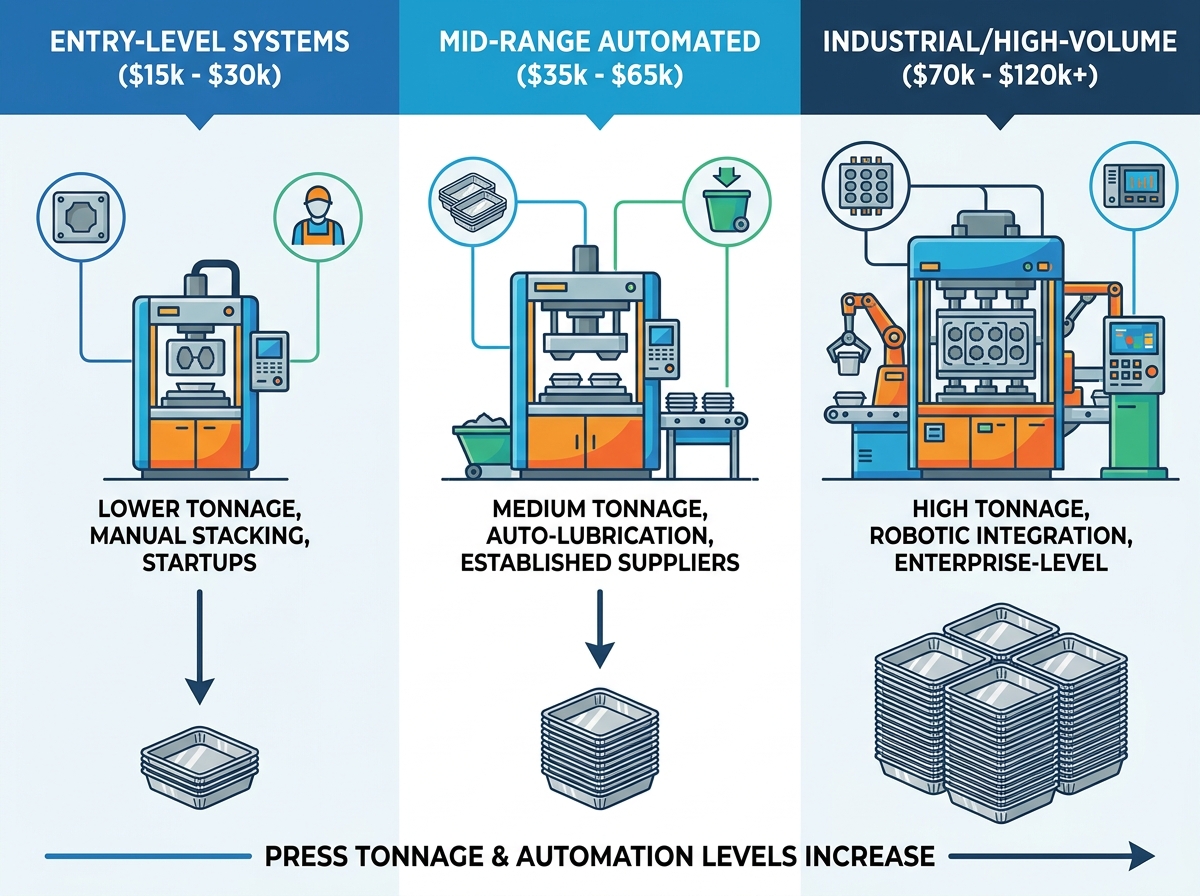
Understanding equipment pricing requires segmenting the market into distinct capability tiers. Manufacturers do not build all machines to the same specifications. Buyers must align their budget expectations alongside their actual production volume needs. We break down the market into three primary categories below.
Table 1: Machine Pricing Tiers Comparison
| Equipment Tier | Estimated Price Range | Press Tonnage | Ideal User Profile |
|---|---|---|---|
| Entry-Level Systems | $15,000 – $30,000 | 25T – 40T | Startups, local regional producers |
| Mid-Range Automated | $35,000 – $65,000 | 45T – 63T | Established packaging suppliers |
| Industrial/High-Volume | $70,000 – $120,000+ | 80T – 130T+ | Enterprise national distributors |
These introductory machines provide a straightforward entry point into the packaging industry. They utilize lower tonnage presses, typically ranging between 25T and 40T. Operators generally rely on manual or semi-automatic stacking mechanisms. The equipment usually runs single-cavity molds. This means the press stamps one tray per stroke.
Startups find this tier particularly attractive. Low-volume regional producers use them for localized market testing. You can test new tray designs without committing massive capital upfront. However, these machines carry distinct limitations. They demand higher direct labor costs because operators must manually gather and pack the finished trays. Cycle speeds remain relatively slow. Furthermore, the lower tonnage restricts your ability to manufacture large, multi-compartment food containers. Heavy-gauge foil will stall or damage a smaller press.
Stepping up to the mid-range tier unlocks serious production capabilities. These setups feature robust 45T to 63T pneumatic presses. They include vital upgrades like automatic lubrication systems. You also gain integrated scrap collection units. Automated single or dual-track stackers replace manual gathering processes entirely.
Established packaging suppliers favor this category. They need consistent, medium-to-high volume throughput every single shift. The primary advantage here is the optimal balance of capital expenditure and labor reduction. Automation handles the repetitive tasks. Your operators simply monitor the line and box the neatly stacked output. They can manage multiple machines simultaneously. This drastically improves your factory floor efficiency.
Enterprise-level production requires heavy-duty industrial systems. These machines boast massive press capacities, ranging from 80T to well over 130T. They support high-speed multi-cavity molds. A single stroke might produce three to six trays instantly. They feature advanced programmable logic controllers (PLCs). They also include automatic scrap balers and seamless robotic packaging integration.
National food chains and large retail distributors demand massive daily quotas. These high-volume systems deliver exactly that. They run continuously across multiple shifts. They handle the thickest foil gauges effortlessly. While the initial investment feels steep, the per-unit production cost drops significantly. You achieve maximum output while employing minimal line staff.
Several underlying engineering choices dictate the final cost of your production line. You cannot evaluate a quote simply by looking at the final number. You must understand exactly what components drive that pricing. Let us explore the critical technical elements.
The core frame of the press dictates its long-term survival. Manufacturers generally use either C-frame or H-frame constructions. C-frame presses open on three sides. This allows easy access for mold changes. However, they can flex slightly under extreme pressure. H-frame designs form a closed, rigid box. They cost significantly more to build. Yet, they provide unparalleled stability. This rigidity dictates your ability to punch thicker foils safely. It prevents micro-vibrations. Vibration causes mold misalignment. Misalignment dulls expensive cutting blades prematurely. When you pay for an H-frame, you buy decades of stable operation.
Precision molds act as the beating heart of your production line. They represent the largest hidden variable cost. Machinists craft these dies from premium alloy steels. They use advanced CNC milling machines to achieve microscopic tolerances. Precision-machined alloy molds naturally cost a premium. They must cut foil cleanly without tearing it. Mold longevity matters immensely. Engineers measure a mold's life in millions of punches. A cheap mold might save you money today. However, it will fail after a few months. A premium die lasts years. It directly impacts the lifetime value of your entire investment.
A bare press cannot produce trays independently. A complete line requires several critical support systems. You need a decoiler to feed the raw aluminum rolls. You require a foil lubricator to prevent tearing during the stamping process. An industrial air compressor drives the pneumatic functions. A scrap aspirator forcefully removes waste foil from the cutting zone. Many budget suppliers quote only the bare press. They leave out these essential components to artificially lower the apparent price. Quotes lacking these items are fundamentally incomplete. You will eventually have to purchase them anyway.
The electronic and pneumatic brains of your machine vary wildly in quality. Generic, unbranded electronics cost very little. They help suppliers hit rock-bottom price points. However, they fail frequently and offer zero global support. Premium machines utilize globally supported components. They feature Siemens, Mitsubishi, or Delta PLCs. They use Festo or SMC pneumatic cylinders. Highlighting this price difference is crucial. When a Siemens PLC fails, you can buy a replacement locally within hours. When a generic controller fails, you might wait weeks for a proprietary replacement from overseas. Downtime quickly destroys any initial savings.
The price tag on the supplier's invoice only tells half the story. Buyers frequently overlook the logistical and infrastructural hurdles involved in deploying heavy machinery. You must budget for these implementation realities carefully.
International freight introduces complex variables. You must carefully review the shipping terms. FOB (Free on Board) means the supplier only covers costs to their local port. You handle the ocean freight. CIF (Cost, Insurance, and Freight) means they cover delivery to your destination port. Beyond ocean container rates, you face import duties. Customs officials will assess tariffs based on the machinery's classification code. Port handling fees, trucking to your facility, and specialized rigging equipment add thousands to your final bill. Always factor these into your initial budgeting phase.
Your factory must be ready to receive industrial equipment. You cannot simply plug a heavy press into a standard wall outlet. High-tonnage presses demand high-draw industrial electrical setups. You may need to upgrade your facility's transformers and electrical panels. Furthermore, heavy machinery vibrates intensely. A standard concrete floor might crack under the repetitive shock of an 80T press. You often must pour heavy-duty concrete foundations. Some installations even require isolated vibration-dampening pads. These infrastructural upgrades require local contractors and specialized engineering permits.
Operating heavy stamping machinery carries inherent physical risks. Local regulators take workplace safety very seriously. Securing verified CE or UL certification demands a premium. These are not merely paperwork exercises. They require tangible hardware upgrades. You must install safety light curtains. These instantly stop the press if an operator's hand enters the danger zone. You need redundant emergency stop relays. Furthermore, pneumatic presses generate extreme noise levels. Enclosed soundproof cabins are often crucial for maintaining OSHA or local workplace compliance. Bypassing these features invites massive legal liabilities.
A machine sitting on your floor produces nothing until your staff knows how to run it. Commissioning requires technical expertise. You must evaluate the cost of bringing vendor-supplied technicians on-site for installation. This usually involves covering their flights, hotels, and daily rates. Some buyers opt for remote video support to save money. This strategy often backfires. The learning curve for staff managing jam-ups is steep. Properly executing complex mold changeovers requires hands-on guidance. Investing in comprehensive, on-site operator training pays massive dividends in long-term reliability.
Comparing quotes from different manufacturers often feels like comparing apples to oranges. Suppliers format their proposals differently. They obscure certain costs while highlighting others. You need a systematic approach to cut through the marketing noise.
Never accept a lump-sum quote. A single price line reading "Aluminum Tray Machine" hides critical details. You must require strict line-item pricing. Demand individual costs for the main press. Ask for the feeder unit price. Isolate the exact cost of the molds. Identify the price of the automated stacker. A comprehensive BOM prevents suppliers from quietly substituting inferior ancillary components. It gives you the leverage to compare specific parts across different vendors accurately.
You should never finalize your payment based on a promise. Mandate a rigorous Factory Acceptance Testing protocol. Demand live video proof of the equipment operating. Better yet, hire a third-party inspection agency to visit the supplier's facility. They must verify the machine running your specific tray design. They must clock the production speed to ensure it matches the promised stroke rate. FAT acts as your ultimate insurance policy. It guarantees the equipment functions perfectly before it ever gets loaded onto a cargo ship.
Warranties look great on paper but often fail in practice. You must contrast a standard "1-year parts warranty" against reality. Investigate the actual availability of critical wear parts. Punching blades, return springs, and optical sensors will inevitably wear out. How fast can the supplier ship replacements? Do they maintain a local warehouse? Extended delivery lead times for simple wear parts will shut down your entire production line. A strong quote includes a bundled spare parts package directly in the initial shipment.
Buying an Aluminum Foil Tray Making Machine fundamentally represents a major infrastructure investment. The lowest initial quote frequently morphs into the most expensive system to operate over time. Inferior components cause downtime. Poorly engineered molds create excessive scrap. You must prioritize stability and ongoing reliability over a cheap upfront sticker price.
We strongly advise mapping your exact capacity needs before engaging vendors. Determine your required trays per minute. Finalize your specific mold designs. Share these exact specifications with multiple suppliers. This strategic groundwork ensures you receive accurate, apples-to-apples comparisons.
Your next steps are clear. Reach out to shortlisted manufacturers and demand highly detailed BOMs. Inquire deeply about their specific FAT protocols. Verify the exact component brands they use. By applying this rigorous evaluation framework, you will build a highly profitable, efficient packaging line.
A: Prices vary significantly, typically ranging from $3,000 to well over $15,000 per mold. The final cost depends heavily on the number of cavities required. It also hinges on the complexity of the rim design, such as demanding G-curl or L-curl formations. Additionally, utilizing premium, high-wear alloy steel grades increases the manufacturing price.
A: Production speed depends entirely on the press capability and mold cavities. Standard machines generally operate between 40 and 60 strokes per minute (SPM). To calculate total output, you multiply the SPM by your cavity count. For example, running a 4-cavity mold at 50 SPM yields an output of 200 trays per minute.
A: Yes, you absolutely need a dedicated industrial air compressor. Pneumatic presses, automated stackers, and scrap blowing systems require a consistent, high-volume supply of compressed air. Shop compressors cannot handle this continuous load. This critical piece of support equipment is usually a separate, necessary purchase.
A: Mold changeover time dictates your facility downtime. Basic, entry-level machines often require 2 to 4 hours for a complete manual changeover and realignment. Conversely, advanced industrial setups utilize quick-die-change (QDC) systems. These specialized pneumatic clamping systems can reduce total changeover time to under 45 minutes.