Views: 0 Author: Site Editor Publish Time: 2026-11-02 Origin: Site
Purchasing an Aluminum Foil Tray Making Machine represents far more than a simple equipment acquisition. It acts as a major capital expenditure dictating your production scalability and long-term unit economics. The global market demand for sustainable, recyclable food packaging continues to surge rapidly across all sectors. Manufacturers face immense operational pressure to balance high-speed output against consistently low scrap rates. If you rely on outdated methods, you risk falling behind faster, more agile competitors. This guide provides an objective, framework-driven approach to evaluating machine specifications, output capabilities, and supplier reliability. We will show you exactly how to assess press mechanics, production limits, and vendor vetting protocols before requesting a formal quote. You will gain actionable insights to make a highly informed, profitable purchasing decision. This approach ensures your facility remains competitive and highly efficient.
Identify your current operational bottlenecks before purchasing new equipment. Are you rejecting lucrative, high-volume contracts due to strict capacity limits? High outsourcing costs often cripple profit margins. Excessive labor dependency also poses a major risk to factory efficiency. You need clear success criteria to justify this upgrade. Industry leaders often measure success through Overall Equipment Effectiveness. A successful acquisition might mean achieving 60 strokes per minute consistently.
It could involve reducing your daily scrap rate by 15%. Transitioning from manual stacking to full automation defines a massive operational win. We see many facilities struggle with manual stacking bottlenecks. Introducing an automated system resolves this immediately. In-house production protects your business against unpredictable supply chain volatility. The food packaging sector demands reliable, on-time output. Owning the equipment guarantees you control the manufacturing schedule entirely. Market alignment requires strategic thinking. Consumers heavily favor fully recyclable aluminum containers over single-use plastics. Bringing production in-house ensures you capitalize on this market shift.
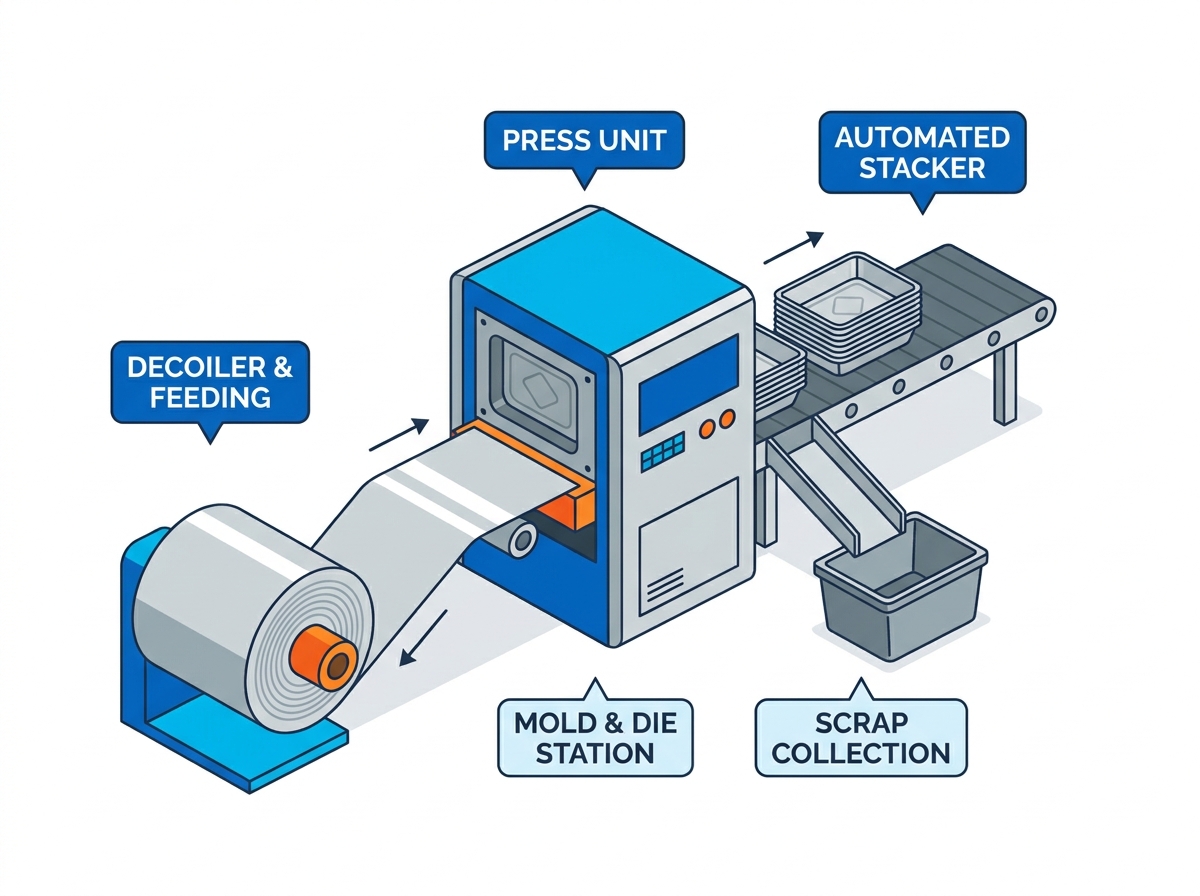
You must understand the distinct components driving these automated lines. Each module plays a vital role in ensuring smooth, continuous production.
Component Performance Summary
| Component | Primary Function | Common Potential Failure Point |
|---|---|---|
| Decoiler | Feeds raw aluminum smoothly | Tension inconsistencies causing tears |
| Press Unit | Stamps and forms the container | Insufficient tonnage for deep draws |
| Mold Station | Cuts and shapes edges precisely | Premature wear leading to rough edges |
| Stacker | Organizes finished products | Sensor misalignment causing jams |
| Scrap Aspirator | Removes waste material safely | Blockages halting the entire line |
Evaluating sheer speed requires looking beyond basic marketing claims. Strokes Per Minute (SPM) serves as a baseline metric. However, SPM combined with the number of mold cavities determines your true hourly output. A machine running at 40 SPM with a four-cavity mold produces 160 trays per minute. You must calculate this theoretical maximum against your realistic operational shifts. Material thickness compatibility demands equal attention. You need to verify the machine's specific tolerance range. This is typically measured in microns. Ensure it handles the specific alloy grades required for your product line. Heavy-duty roasting pans require much thicker gauge aluminum than standard takeout containers. If the press lacks sufficient power, thick materials will jam or form improperly.
Choosing the right press mechanics profoundly impacts your daily operations. You must weigh the benefits and limitations of each system carefully.
Pneumatic systems operate using compressed air. They offer several distinct advantages for modern facilities.
However, pneumatic presses carry specific limitations. They require a robust, highly reliable factory air supply. They also feature a lower maximum tonnage capacity. This limits their effectiveness for extremely deep or thick containers.
Hydraulic systems rely on pressurized fluid to generate force. They excel in heavy-duty manufacturing environments.
Their limitations include slower overall cycle times. They also present potential fluid maintenance issues. Leaks can contaminate the production floor if not monitored strictly. You must factor routine fluid changes into your preventive maintenance schedule.
Changeover times dictate your operational agility. You must evaluate how long it takes a single operator to swap molds. Quick-change mold systems allow facilities to switch product sizes rapidly. This proves invaluable for businesses handling varied, smaller-batch production runs. Extended changeovers eat into your daily output metrics directly. You also face a choice between custom and standard dies. Proprietary molds often lock you into a single vendor ecosystem. We strongly advise selecting machines accepting standard industry tooling. This flexibility allows you to source replacement dies from multiple suppliers. It protects your operation from vendor bottlenecks. It also speeds up replacement timelines when parts wear down.
Procuring the equipment marks only the first step. You must manage the setup and rollout meticulously. This phase carries significant operational risks if handled poorly. Always demand a comprehensive Factory Acceptance Testing (FAT) protocol. We advise buyers to mandate video or in-person FAT sessions. You must insist vendors use your specific raw materials during this test. Generic aluminum foil behaves differently than specialized, lubricated alloys. Foil thickness variations cause unexpected tearing. Verifying performance with your exact material prevents costly surprises upon delivery. Do not release final payment until the machine meets every agreed-upon benchmark.
Set realistic expectations for lead times. Manufacturing an industrial press requires extensive engineering. Custom mold machining takes weeks to perfect. International shipping often adds 60 to 120 days to the timeline. You must factor these delays into your launch schedule. Rushing the process often results in substandard tooling or skipped quality checks. Operator training remains a critical, frequently overlooked factor. These machines feature high levels of automation. However, they still require highly skilled technicians to function correctly. Operators must know how to troubleshoot tension issues safely. They must understand how to clear material jams without damaging delicate mold edges. They also need proper training to maintain dies and perform routine lubrication. Do not assume automated machinery runs itself entirely.
Navigating the global supplier landscape requires strict vetting protocols. You must separate reliable partners from simple equipment brokers. Start by mandating thorough verification checks. You need to confirm verified CE or ISO certifications. Do not accept digital badges at face value. Request the actual certificate numbers and verify them independently through official databases. Ask vendors for reference sites or documented case studies. Focus on finding examples in similar climates or regions. Humidity and temperature fluctuations can affect pneumatic systems and lubrication significantly. A machine operating flawlessly in a dry, temperate climate might struggle in high humidity environments without proper air dryers.
Assess the supplier's after-sales infrastructure aggressively. Your Aluminum Foil Tray Making Machine will eventually require spare parts. Evaluate their ability to ship critical replacements quickly. Ask if they provide remote PLC troubleshooting services. A vendor who can diagnose software faults remotely saves you days of downtime. Take an actionable next step today. Encourage your engineering team to consolidate your tray blueprints. Gather your required hourly output metrics. Document your specific factory voltage and air supply specifications. Combine all these details into a unified Request for Quotation (RFQ) document. Sending a structured RFQ ensures you receive accurate, comparable bids from every supplier.
Acquiring an aluminum foil tray making machine demands a strategic approach. It requires balancing upfront tonnage and automation investments against long-term operational efficiency. We encourage decision-makers to prioritize mold compatibility above all else. Robust post-sale support matters far more than securing the absolute lowest initial bid. Focus on building a reliable, flexible production line. Take the time to consult directly with a technical sales engineer. They can help you map out the exact specifications your facility needs to thrive. Proper planning transforms this machinery into a dependable engine for business growth.
A: Yes, you can produce multiple sizes by changing the mold. However, the machine's maximum tonnage and physical bed size strictly limit the maximum dimensions you can run. These constraints also limit the total cavity count of any replacement molds you install.
A: High-quality steel molds typically complete millions of strokes before requiring professional intervention. You must ensure proper, consistent lubrication and routine maintenance to reach this lifespan. Eventually, they will require professional re-sharpening or complete replacement to maintain clean tray edges.
A: Yes, pneumatic press models and automated stackers rely heavily on consistent, dry, high-pressure air. A dedicated industrial compressor ensures they function smoothly. Insufficient air pressure causes stalling, sensor faults, and severe material jams across the entire production line.
A: Scrap rates depend entirely on your specific mold design, particularly the webbing required between cavities. Fortunately, this scrap is 100% recyclable. Most automated lines include a scrap aspirator or baler to collect this material efficiently for easy resale.