Views: 0 Author: Site Editor Publish Time: 2026-11-01 Origin: Site
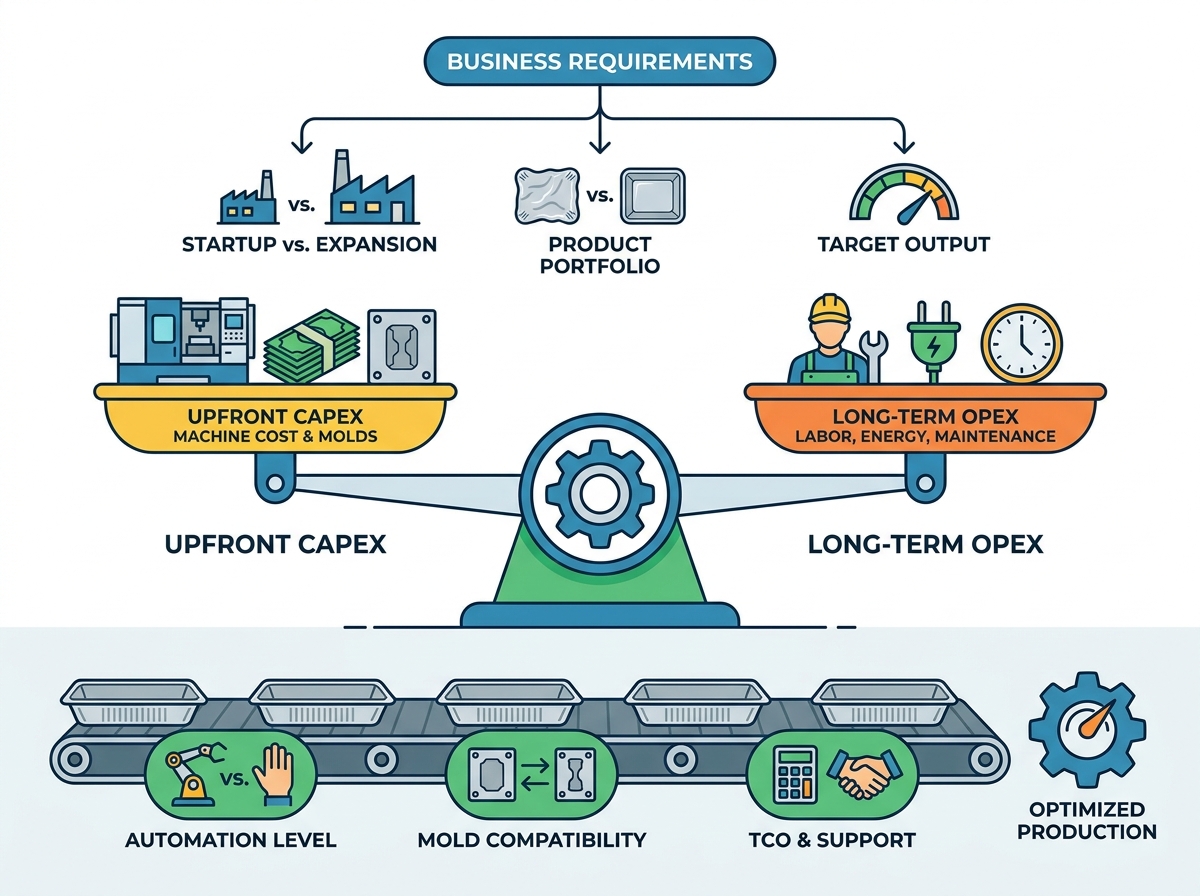
Investing in container manufacturing equipment represents a major capital decision. Miscalculating capacity, mold compatibility, or automation levels can quickly erode your profit margins. Whether you scale an existing packaging facility or launch a new production line, selecting the right equipment remains vital. You must carefully balance upfront capital expenditure against long-term operational efficiency. Buying the wrong machinery often leads to high scrap rates. It can also cause slow changeovers and frequent mechanical failures.
This guide provides a clear framework to evaluate equipment specifications effectively. You will learn how to match machine capabilities to your business model. We will explore core technical requirements, from press tonnage to automated integrations. You will also learn how to identify potential hidden risks before finalizing your purchase. Finally, we provide strategies to properly vet manufacturers before you request a formal quote.
You must align your equipment choices with your current business maturity. Facilities have vastly different needs based on their growth stages. Understanding your exact market position prevents costly over-investments. It also ensures you do not buy an underpowered system.
Startups should prioritize versatile, mid-speed machines. These flexible systems allow operators to learn the trade smoothly. They also handle smaller production runs efficiently. In contrast, established plants demand different solutions. They typically require high-speed, multi-cavity dedicated lines. Established facilities focus heavily on maximizing output per hour. They rely on machines optimized for continuous, heavy-duty production cycles.
You must define the exact trays you intend to produce. Different products require vastly different mechanical setups. Standard wrinkled-wall containers forgive minor tooling variations. High-end smooth-wall containers demand extreme precision. Specialized airline catering containers require rigorous dimension controls. Mapping your portfolio ensures you select compatible press dynamics. If you plan to produce smooth-wall containers, you need specialized lubrication systems. You also need heavy-duty molds designed specifically for deep drawing.
Many buyers confuse theoretical speed with actual yield. A machine's Strokes Per Minute (SPM) indicates its theoretical maximum speed. However, your realistic operational yield will always be lower. You must account for several inevitable delays.
Calculate your daily targets using realistic yield numbers. A machine rated at 60 SPM might realistically average 45 SPM throughout a full shift.
Mechanical specifications directly dictate your factory's capabilities. Choosing the right Aluminum Foil Tray Making Machine requires examining its structural components. Substandard parts lead to rapid wear and compromised product quality.
Tonnage represents the actual pressing force of the machine. Common configurations include 45T, 63T, and 80T capacities. Higher tonnage allows you to mount larger molds. This means you can punch more cavities per single stroke. A 45T press easily handles a two-cavity standard mold. However, an 80T press effortlessly manages a four-cavity or six-cavity setup. Remember, heavier machines require stronger factory floors. They also consume significantly more industrial power. Match your tonnage precisely to your largest anticipated mold.
The feeding system pulls the aluminum foil into the press. Precision here remains absolutely critical. Evaluate the quality of the CNC servo feeders. High-quality servos guarantee exact step lengths. Inaccurate feeding leads to catastrophic scrap rates. It quickly causes jammed molds and damaged tooling. A reliable feeding unit keeps material tension perfectly consistent. It prevents wrinkles before the foil even enters the die.
Pay special attention to the clutch and brake systems. Traditional mechanical friction clutches often wear out quickly. They struggle during high-speed, continuous operations. High-frequency pneumatic dry friction clutches provide a superior alternative. They offer vastly better safety protocols. Pneumatic clutches stop the press almost instantly during emergencies. They deliver exact stopping precision, protecting both operators and expensive molds. Always prioritize pneumatic setups for modern manufacturing.
Every single stroke generates leftover aluminum web scrap. How the machine handles this scrap defines your operational flow. Manual scrap removal demands constant labor and halts production. Integrated automatic scrap aspirators suck waste directly away from the mold. Scrap balers crush this waste into dense blocks. These integrated systems are essential for continuous operation. They also maximize your recycling revenue by condensing material for transport.
Modern production facilities thrive on efficient automation. Upgrading your systems reduces human error. It also stabilizes your daily output rates. You must evaluate how well new equipment fits your workflow.
Table: Production Line Setup Comparison
| Feature | Semi-Automatic Line | Fully Automatic Line |
|---|---|---|
| Stacking Method | Manual gathering by operators | Auto-stackers (single/multi-lane) |
| Labor Needs | High (2-3 operators per line) | Low (1 operator supervising) |
| Production Speed | Limited by human handling | Maximized machine capability |
| Capital Cost | Lower initial investment | Higher initial investment |
Labor shortages continue to plague the packaging industry. You should carefully compare the labor costs of manual stacking against automated solutions. Semi-automatic setups rely on workers catching and boxing trays. This limits your maximum production speed. Investing in automatic stackers drastically changes this dynamic. Multi-lane drop stackers organize trays perfectly into counted sleeves. The savings in hourly wages often cover the equipment upgrade quickly.
Your production does not end at the stacker. Consider machines that integrate seamlessly with downstream equipment. Shrink-wrapping machines prepare tray sleeves for retail display. Carton-packing equipment boxes the products for palletizing. True line integration means these machines communicate electronically. If the shrink-wrapper jams, the main press should automatically pause. This prevents chaotic bottlenecks on your factory floor.
Operators interact daily with the Human-Machine Interface (HMI). Look for sophisticated PLC-controlled systems (Programmable Logic Controllers). The best systems utilize intuitive, full-color touch screens. Modern HMIs allow operators to save specific mold parameters. When you change a mold, the operator simply loads the saved recipe. This instantly sets the feeding length, press speed, and stacker timing. Digital recipes drastically reduce human error and slash changeover times.
Equipment procurement involves far more than the initial invoice. You must anticipate the ongoing expenses required to run your factory. Ignoring these hidden risks heavily damages long-term profitability. Careful planning secures your financial forecasts.
Industrial power usage represents a massive monthly expense. You must assess the kilowatt (kW) rating of the entire line. This includes the feeder, the main press, stackers, and scrap balers. Calculate expected monthly power costs based on your local utility rates. A highly efficient servo motor might cost more upfront. However, it will consume significantly less electricity over a five-year period.
Molds are significant, recurring investments in this industry. Do not underestimate their financial impact. High-quality steel molds carry premium price tags. Yet, they last for millions of strokes before needing refurbishment. Cheap molds deform quickly under heat and pressure. This leads to rejected trays and angry clients. Treat mold acquisition as a critical infrastructure investment, not a casual purchase.
Buying overseas equipment introduces heavy logistical variables. You must factor in massive shipping dimensions and weight limits. Sea freight costs fluctuate wildly based on global conditions. Calculate all local import duties and port handling fees early. Additionally, clarify whether the vendor provides on-site commissioning. Flying out a foreign technician for operator training adds major travel expenses.
Every hour your machine sits broken costs you money. Avoid machines built with proprietary, hard-to-source wear parts. If a custom relay breaks, you might wait weeks for international shipping. Prioritize equipment using standardized electrical and pneumatic components. Brands like Siemens, Festo, and Schneider are globally available. You can purchase replacements at local industrial supply stores, minimizing downtime risks.
The manufacturer you choose becomes your long-term business partner. A poor vendor disappears once the final payment clears. You must vigorously vet their credentials before signing contracts.
Operator safety is completely non-negotiable. Insist on strict CE or ISO certifications from the manufacturer. Demand detailed documentation proving compliance. Examine the operator safety guards specifically. The machine must feature sensitive infrared light curtains. It needs multiple, easily accessible emergency stop buttons. Safety doors should include electronic interlocks preventing operation when open. Do not compromise on worker protection.
Never authorize a final payment blindly. Demand a documented Factory Acceptance Testing (FAT) procedure. The vendor must run the machine at their own facility first. They must use your specific aluminum foil gauge. They must test your actual mold design under continuous speed. Request unedited video footage of this test. Better yet, attend the FAT in person or hire a local third-party inspector. This guarantees the machine works perfectly before it boards a ship.
Clarify all warranty terms in writing. A solid Service Level Agreement (SLA) defines responsibilities clearly. Ask about their remote diagnostic capabilities. Modern PLCs connect to the internet, allowing vendor engineers to troubleshoot software bugs remotely. Ensure they offer guaranteed response times for technical support. Knowing you have 24/7 access to engineering help provides massive peace of mind.
Selecting an optimal machine requires looking far beyond the sticker price. You must carefully evaluate mechanical precision, from pneumatic clutches to servo feeders. You must assess automation capabilities to protect yourself from labor shortages. Furthermore, prioritizing tooling durability guarantees consistent product quality for your clients.
Your next step is practical action. Draft a standardized Request for Quotation (RFQ). Include your specific tray drawings and target dimensions. State your required daily output clearly. Specify your local voltage and electrical requirements. Send this unified RFQ to multiple vetted vendors. This structured approach allows you to compare manufacturers accurately and secure the best possible equipment for your facility.
A: Realistic changeover times typically range from 2 to 4 hours. This depends heavily on the machine's die-lifter systems and operator skill. Machines equipped with heavy-duty pneumatic die lifters and digital PLC recipe saving complete this process much faster.
A: Yes, the primary press can handle both. However, the mold designs differ completely. Smooth-wall production also demands much higher feeding precision. It frequently requires specialized food-grade lubrication systems that standard wrinkled-wall setups might lack.
A: Standard lead times usually fall between 45 and 90 days. This timeline accounts for structural assembly, wiring, and custom mold fabrication. Complex multi-cavity molds often dictate the longest portion of this manufacturing schedule.
A: Standard machines process foil gauges ranging between 30 to 120 microns. Processing thicker gauges requires specific adjustments to the press configuration. It also demands stronger pneumatic clamping in the feeding servo to prevent material slippage.