Views: 0 Author: Site Editor Publish Time: 2026-10-29 Origin: Site
Deploying mismatched cutting equipment creates severe operational bottlenecks on modern factory floors. Manufacturers routinely face excessive material waste, rapid blade degradation, and irreversible thermal distortion when using incorrect tools. Selecting an industrial Saw Blade Machine serves as a primary driver of production throughput and overall cut quality. It represents far more than a simple capital expense. Your choice directly dictates facility efficiency. Poorly matched equipment ruins expensive alloys, stalls assembly lines, and compromises operator safety.
This article evaluates various saw blade machine variants objectively. We map specific technical features to distinct industrial applications to guide your decision-making process. You will gain a practical framework to ensure your next procurement aligns perfectly with exact shop floor realities.
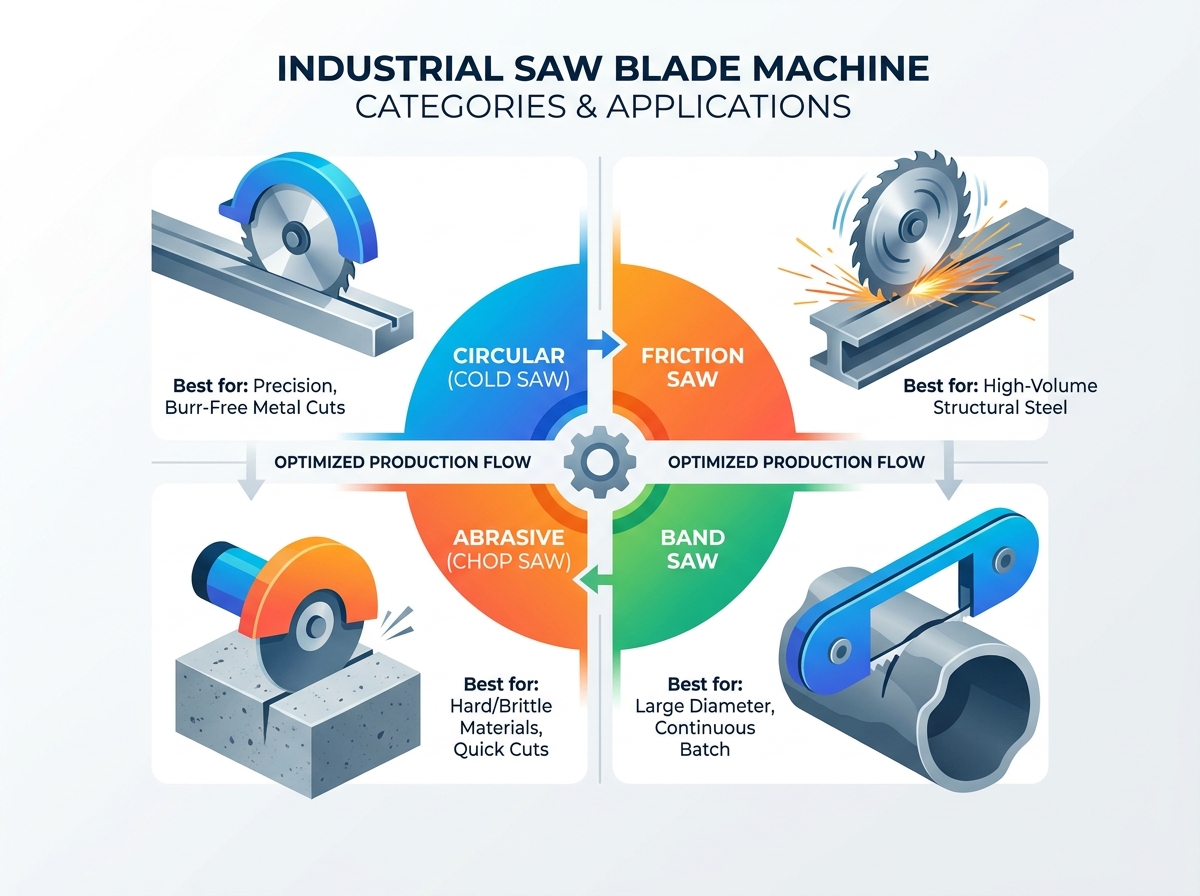
We must define the main solution categories by looking at the physical mechanics of the cut. This approach prevents over-promising theoretical capabilities. Different raw materials demand entirely distinct cutting actions to yield clean edges.
Cold saws use toothed blades to shear material at low RPMs. They transfer the heat generated during cutting directly into the chip rather than the workpiece. You get clean, burr-free cuts consistently. They work exceptionally well for precision cutting in ferrous and non-ferrous metals. Operators appreciate cold saws because they eliminate secondary deburring processes. The slow rotational speed preserves the temper of the metal alloy being processed.
Friction saws operate at extremely high speeds. They use intense friction to soften metal just ahead of the blade edge. The blade then sweeps the softened metal away effortlessly. These units are best for high-volume cutting of structural steel and hardened alloys. In these heavy industrial scenarios, finish quality remains secondary to raw speed. They slice through thick carbon steel rapidly, keeping continuous production lines moving without delay.
Instead of shearing, abrasive saws use composite abrasive wheels to grind through material. You use them mostly for hard, brittle materials. They also excel at quick, non-precision cross-cutting in rugged environments. Construction crews rely on them because they handle dirt, grit, and imperfect conditions easily. While they leave a rougher edge, they push through concrete, rebar, and hardened strut channels where traditional teeth would snap immediately.
Band saws utilize a continuous metal band featuring teeth driven by two or more wheels. They distribute wear over a much longer cutting edge. You should deploy them for large diameter materials, irregular shapes, and continuous batch cutting. They produce very narrow cuts. This narrow profile minimizes kerf waste, saving expensive raw material over time. They handle giant bundles of steel tubing just as easily as solid titanium billets.
Decision-makers need an objective matrix connecting machine features to production outcomes. Evaluating an industrial Saw Blade Machine requires examining its core engineering. Focus on structural integrity rather than flashy aesthetics.
You must compare direct drive mechanisms against gear or belt reduction systems. Direct drives provide immediate power. Gear-driven systems multiply torque effectively at the spindle. High torque consistency prevents blade binding during deep cuts in dense alloys. When a machine maintains steady RPM under a heavy load, it prevents catastrophic blade failure and protects the motor.
Rigidity determines final cut accuracy. Heavy-duty cast iron bases and reinforced steel trunnions absorb operational vibration. Operational vibration destroys blade teeth rapidly. A rigid arbor setup directly extends blade life and ensures tighter tolerances on the finished part. It prevents blade deflection when you cut complex profiles or asymmetrical shapes.
Thermal regulation maintains the metallurgical integrity of your workpiece.
Inadequate material securing creates severe safety and precision risks. Poorly clamped stock chatters violently against the blade.
Procurement Feature Evaluation Matrix
| Feature | Primary Function | Operational Impact |
|---|---|---|
| Direct Drive System | Transfers motor power directly to the blade arbor. | Reduces energy loss; ideal for high-RPM precision cuts. |
| Gear Reduction Drive | Multiplies torque through internal gearing. | Prevents stalling in dense metals; perfect for cold saws. |
| Cast Iron Trunnions | Anchors the arbor and absorbs vibration. | Increases cut accuracy and extends consumable lifespan. |
| Hydraulic Vise | Clamps materials using hydraulic fluid pressure. | Eliminates material chatter; crucial for heavy structural steel. |
Aligning machine types with specific operational use cases facilitates accurate shortlisting. You avoid over-equipping or under-equipping your facility by mapping your exact needs to proven technology.
Structural applications demand friction saws or heavy-duty dual-column band saws. Facilities processing massive I-beams, H-beams, and thick-walled tubing need immense raw power. A friction saw pushes through structural steel quickly. Dual-column band saws handle massive bundle cuts efficiently. Both options prioritize throughput over microscopic tolerances. They keep shipyards and structural fabricators moving.
Aerospace components demand tight-tolerance processing. You process heat-sensitive alloys like titanium and aerospace-grade aluminum daily. These delicate materials require cold circular sawing machines. Cold saws shear metal slowly, preventing work-hardening of the cut edges. They preserve the structural integrity of the metal, ensuring downstream CNC machining proceeds without tool breakage.
Wood and composite manufacturing rely on high-RPM circular panel saws. They require specialized carbide-tipped blades. Composite materials splinter easily. Specialized scoring blades often pre-cut the material surface before the main blade finishes the cut. You achieve splinter-free dimensional processing essential for furniture or cabinet manufacturing. Dust extraction is equally critical here.
Fieldwork favors portable abrasive saw machines. Construction sites feature harsh environmental conditions. You cut rebar, strut channels, and masonry often covered in dirt or cement. Abrasive saws tolerate these abrasive contaminants far better than precision toothed blades. They sacrifice finish quality for extreme ruggedness and portability, making them indispensable on job sites.
Procuring heavy machinery introduces specific rollout challenges and hidden expenses. Transparency regarding these obstacles ensures successful implementation. Facility managers must look beyond theoretical specifications and plan for physical integration realities.
Every cutting process consumes tools. You must factor in the frequency of blade resharpening versus constant replacement. Cold saws use expensive blades. However, you can resharpen them dozens of times. Abrasive chop saws use cheap wheels. They wear down rapidly and require constant replacement. You need to align your operational budget with these distinct consumable frequency models to prevent unexpected supply shortages.
Industrial machinery demands robust infrastructure. Consider the electrical footprint carefully. Most heavy-duty units require dedicated 3-phase power, typically 480V. You also must account for physical footprint space. Beyond the machine dimensions, operators need room to maneuver long raw materials safely. Furthermore, wood and composite processing necessitate compliant dust and chip extraction systems to prevent atmospheric hazards.
Cutting raw material presents intrinsic dangers. You must outline mandatory safety guards prior to installation. Facilities must implement rigorous emergency stop protocols. Operators need extensive training on lockout/tagout (LOTO) procedures before touching the equipment. OSHA and ISO compliance checks are mandatory. Failure to secure safety perimeters exposes your workforce to severe injury and your business to massive liabilities.
Machines break down without proactive care. You must plan for necessary maintenance downtime. Gearboxes require fluid changes. Abrasive wheels need truing. Operators must calibrate band saw blade tension regularly. Ignoring these tasks accelerates equipment failure. Establish strict preventative maintenance schedules to maximize machine availability and protect your initial investment.
Closing the evaluation phase requires a step-by-step decision framework. Follow this logical sequence to secure the ideal Saw Blade Machine for your facility.
No single industrial saw blade machine fits all manufacturing contexts perfectly. Successful procurement balances initial machine rigidity against long-term consumable efficiency. We strongly recommend consulting directly with an applications engineer. They will finalize your machine specifications based on exact shop floor realities. By auditing your materials, matching the physical cutting mechanics, and rigorously evaluating safety requirements, you guarantee a highly productive installation. Making an informed choice secures reliable throughput for years to come.
A: A cold saw uses a toothed metal blade turning at low RPMs to shear material. It transfers heat into the chips, resulting in clean, burr-free cuts. An abrasive saw uses a high-speed composite wheel to grind through material. It creates significant heat, leaving rough, burred edges requiring secondary finishing.
A: Replacement frequency depends heavily on material hardness, feed rates, and machine rigidity. Cutting soft aluminum allows a blade to last weeks. Cutting dense titanium dulls teeth in days. Track your cost-per-cut closely. Once cut quality degrades or cycle times increase noticeably, you must replace or resharpen the blade immediately.
A: We strongly advise against cutting both wood and metal on the same machine. This practice causes severe cross-contamination. Hot metal shavings mix with dry wood dust, creating dangerous fire hazards. Furthermore, wood and metal require completely different RPM settings and fundamentally incompatible blade tooth geometries for safe processing.
A: Key safety standards involve strict OSHA compliance. Machines require fixed guarding around moving parts. Facilities must enforce rigorous lockout/tagout (LOTO) procedures during maintenance. Localized exhaust ventilation systems are also mandatory to extract toxic fumes or combustible dust generated during the cutting process.