Views: 0 Author: Site Editor Publish Time: 2026-10-27 Origin: Site
Purchasing a Saw Blade Machine is never a simple tool acquisition. You are making a critical capital expenditure. This choice directly impacts production bottlenecks, material yield, and facility safety. You face serious operational risks if you specify poorly. Under-specifying leads to premature wear, inaccurate cuts, and costly downtime. Your team will constantly struggle to meet quotas. Over-specifying drains your capital budget unnecessarily. It also demands excessive floor space for underutilized features.
Our guide moves you beyond standard specification sheets. We provide a rigorous evaluation framework. You will learn how to align machine capabilities exactly to your manufacturing requirements. We will explore ways to meet your throughput goals efficiently. You will also discover strategies to streamline implementation on the factory floor. Proper equipment selection transforms raw material processing entirely. It builds a robust foundation for scalable enterprise growth. We will show you how to evaluate key factors logically before you buy.
Before exploring catalogs, you must analyze your current production floor extensively. Identify the core business problem driving this massive upgrade. Walk the line and observe the workflow. Are bottlenecks stemming from agonizingly slow cutting speeds? Do poor cuts force your team into secondary finishing operations like deburring or edge routing? Perhaps slow setup times between different production batches drag down your daily output. You need clear, data-backed answers here. Identifying these gaps ensures you target the exact features you need.
Different materials demand unique machine architectures. A one-size-fits-all approach guarantees failure. Consider these specific constraints carefully:
Finally, analyze your production volume and duty cycle realistically. Intermittent use in prototyping shops differs vastly from a continuous three-shift operation. High-volume environments require heavy-duty cast iron trunnions. They also demand continuous-duty motors designed for relentless operation. Lighter duty machines will literally shake themselves apart under 24/7 strain.
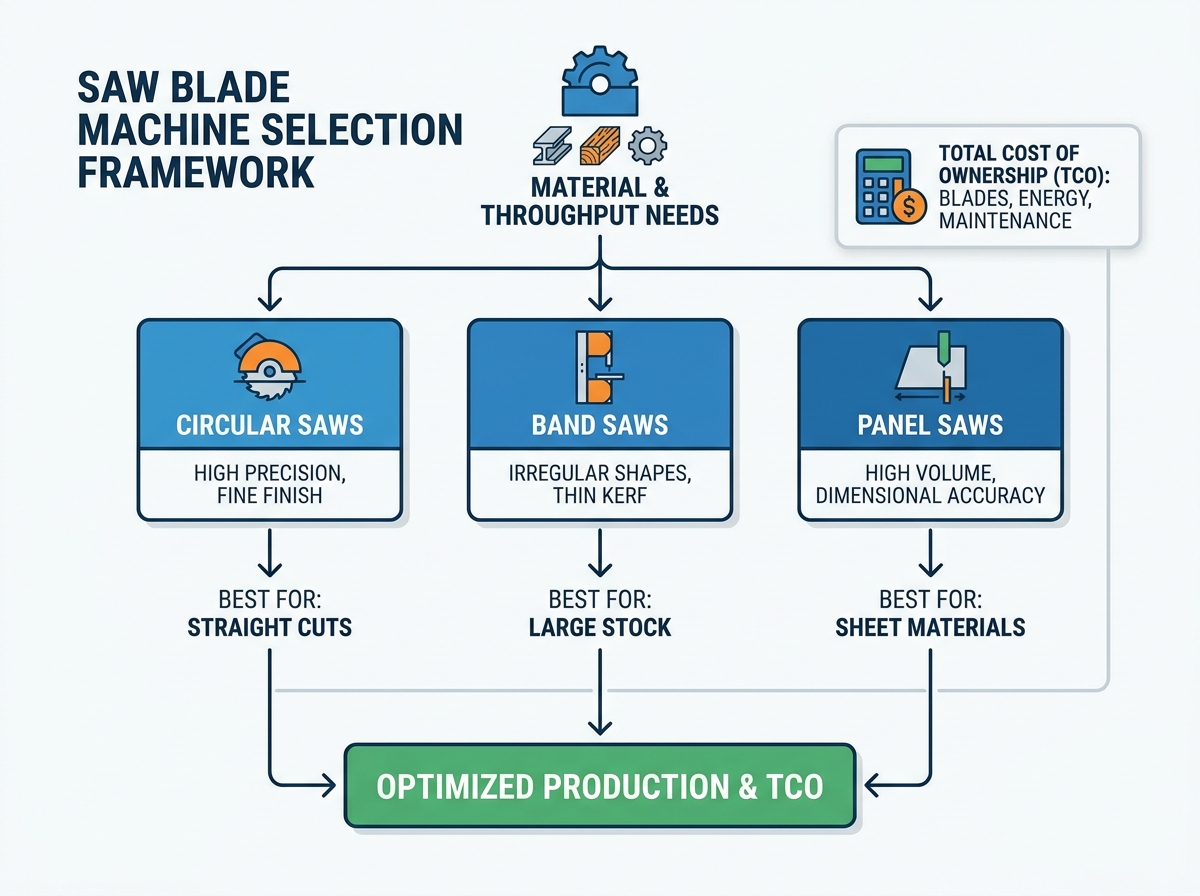
We must match your application to the correct structural design. Three primary categories dominate the industrial landscape. Each serves a very specific manufacturing ecosystem.
These units excel at high-precision, straight cuts. They deliver exceptionally fine finishes needing minimal secondary deburring. Operators appreciate their straightforward mechanics and reliable geometry. However, blade diameter strictly limits your maximum depth of cut. You cannot process massive billets on standard circular equipment. You also face higher consumable replacement cycles if operators ignore routine maintenance. Heat buildup ruins these tools quickly if coolant runs dry.
Band saws handle large-diameter stock perfectly. They cut structural steel, pipes, and irregular shapes highly efficiently. Their continuous loop design and thinner kerf provide excellent material yield. This efficiency saves massive amounts of material when cutting expensive alloys. Unfortunately, they cut slower than circular models. Tensioning systems must be robust and perfectly calibrated. If tension drops, you risk severe blade drift and angled cuts. This ruins dimensional accuracy instantly.
Panel saws dominate high-volume sheet processing facilities. They cut full sheets of plywood, MDF, and large plastics rapidly. You achieve exceptional dimensional accuracy across large spans. Digital fences ensure every panel matches the required dimensions perfectly. The trade-offs include a massive facility footprint. You must ensure you have the continuous volume to justify the floor space dedicated to this workflow.
Machine Category Comparison Summary| Category | Best Used For | Primary Limitation | Material Yield |
|---|---|---|---|
| Circular Saws | High-precision, fine finish straight cuts | Cut depth strictly restricted by tool size | Moderate (thicker kerf) |
| Band Saws | Large stock, structural shapes, heavy billets | Slower speeds, potential drift under load | High (very thin kerf) |
| Panel Saws | High-volume sheet materials processing | Massive facility footprint required | High (optimized nesting) |
Choosing your equipment requires a deep dive into engineering specifics. Spec sheets often obscure real-world performance under marketing jargon. You must look past superficial metrics to find true capability.
Do not look solely at horsepower ratings. Peak horsepower means very little during a grueling continuous shift. Instead, evaluate continuous torque curves. Torque is what pulls the teeth through dense material without stalling. You should look exclusively for Variable Frequency Drives (VFDs). A VFD allows operators to tune speeds precisely for different materials. This tuning maximizes tool life and improves cut quality simultaneously.
Examine the drive mechanisms closely. Direct-drive systems offer superior power transfer. They eliminate power loss between the motor and the spinning arbor. This ensures maximum efficiency during heavy cuts. Belt-driven systems act as a buffer against sudden shock loads. If a piece jams, the belt slips instead of destroying the motor. However, belts require regular tensioning maintenance to prevent power-sapping slippage.
Machine weight is a crucial indicator of overall quality. You want massive cast iron or heavy gauge steel bases. Mass dampens vibration effectively. Excessive vibration is the primary cause of premature tool failure. Micro-vibrations shatter carbide tips. Vibration also guarantees a poor cut finish characterized by deep chatter marks.
Evaluate the linear guides and bearing assemblies. Manufacturers often make bold tolerance claims. These claims must hold true under heavy, continuous loads. Free-spinning tests prove nothing. Heavy-duty, sealed bearings ensure the arbor runs perfectly true over years of gritty service. Demand to see deflection test results.
Modern manufacturing requires deep digital connectivity. Assess whether the equipment integrates easily into your existing ERP or CAD/CAM environment. Many advanced models pull cut-lists directly from your production software. This automation eliminates manual data entry errors completely. It ensures seamless workflow from the design office to the factory floor.
You should also evaluate physical material handling capabilities. Automated in-feed and out-feed rollers drastically reduce manual operator intervention. Auto-indexing systems pull raw stock forward precisely to the exact millimeter. Bundle-cutting clamps allow you to process multiple structural pieces simultaneously. These features compound daily throughput exponentially. They transform a standalone tool into an integrated production cell.
Buying the equipment is only the first step of the journey. You must plan meticulously for long-term operational realities. A poorly integrated system disrupts the entire factory workflow.
A budget-friendly unit often lacks structural rigidity. The resulting micro-vibrations destroy expensive industrial cutting tools rapidly. You must view consumable longevity as a major operational metric. Solid, vibration-free operation extends tool life significantly. This durability reduces constant changeovers and agonizing downtime. A rigid frame dramatically prolongs replacement cycles over multiple years of operation.
You must map out facility requirements early in the procurement process.
Industrial hardware fails eventually. When it does, your support network matters most. Evaluate vendor Service Level Agreements (SLAs) carefully. Check the domestic availability of proprietary replacement parts. A missing sensor should not halt your entire production line for weeks. Finally, gauge the ease of performing daily calibration. Operators must perform alignment and tensioning tasks quickly. If these tasks are overly complex, workers will skip them, leading to ruined materials.
Industrial environments present serious hazards daily. Your chosen equipment must prioritize human safety comprehensively. Patchwork safety fixes rarely survive daily production rigors.
The system must meet strict regional safety standards out of the box. Buyers in the US must demand strict OSHA compliance. European buyers require full CE certification. Look for standardized, tested compliance documents. Ignore proprietary vendor safety claims lacking independent certification. Standardized compliance guarantees predictable regulatory audits and keeps workers secure.
Enterprise deployment demands non-negotiable active safety integrations.
Material processing creates significant airborne and physical debris. Evaluate the integrated chip conveyors carefully. They keep the operational area clear of dangerous, sharp metal shards. Look closely at mist lubricator enclosures. They prevent slippery floors and dangerous airborne coolant inhalation. Finally, demand proper connection ports for centralized dust extraction systems. Proper extraction mitigates highly combustible dust hazards. It also eliminates serious respiratory risks for your workforce.
Upgrading your cutting infrastructure transforms your production efficiency completely. Selecting the right equipment requires systematic testing and clear internal audits. Do not rely on brochures alone.
Next Steps for Your Business:A: Most machines accept standard arbor sizes and lengths. This flexibility allows you to source consumables competitively across the market. However, some highly automated CNC models require specific pin-hole configurations. You should always verify open-market compatibility before purchasing to avoid permanent vendor lock-in.
A: The return period generally ranges from 12 to 24 months. This timeline is driven primarily by drastically reduced scrap rates through optimized nesting. It also stems from lower direct labor costs. Faster cutting speeds contribute, but operational yield drives the main value.
A: A VFD allows the operator to perfectly match the RPM to your material's specific hardness. It also accounts for thermal properties dynamically. This precise control prevents excessive heat buildup. Heat is the leading cause of dulling, warping, and premature tool failure.
A: Common requirements include installing dedicated 3-phase power drops. You often need reinforced concrete flooring to level heavy cast-iron bases properly. Upgraded HVAC and specialized dust collection ducting are also usually mandatory to maintain strict safety compliance.