Views: 0 Author: Site Editor Publish Time: 2026-10-26 Origin: Site
B2B manufacturers face a significant dilemma when upgrading facility equipment. You must balance upfront capital expenditure against long-term operational costs. Production bottlenecks also demand your immediate attention. Choosing incorrectly often leads to wasted resources. It can also cause you to miss key market opportunities. Global demand for food-grade packaging is rising rapidly today. This trend makes production efficiency a critical competitive edge. Meeting high-volume orders requires reliable machinery and smart resource allocation.
Choosing the right equipment is not about finding the best technology overall. It is about finding the exact match for your specific facility. You must align your investment carefully. Consider your production volume, your local labor market, and your available floor space. In this article, you will discover the key differences between manual and automatic setups. We will explore capacity thresholds and financial impacts. You will walk away ready to make an informed machinery choice.
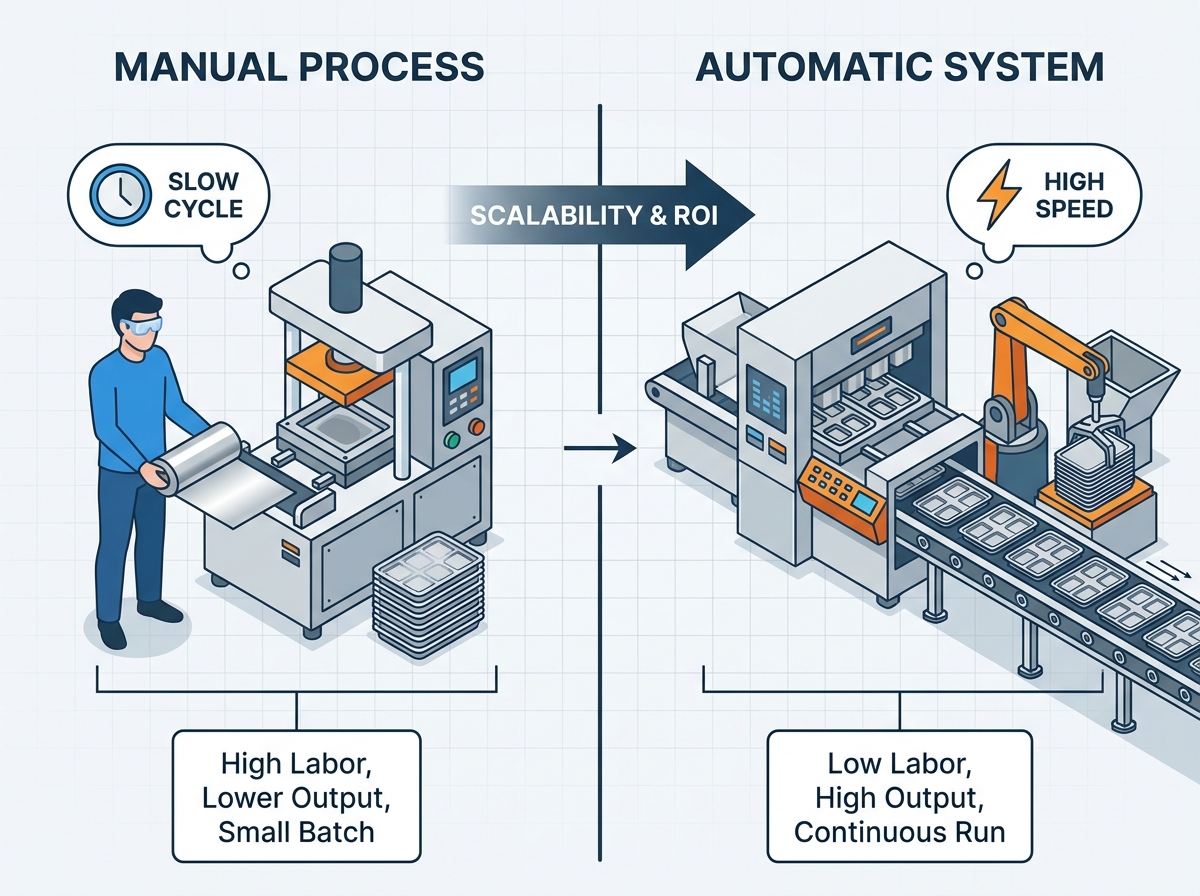
Manual and semi-automatic systems represent the traditional starting point for many manufacturers. They require human operators for almost every step. Workers must manually feed the aluminum foil into the press. They physically trigger the stamping process. After stamping, operators collect and stack the finished trays by hand. This workflow relies heavily on continuous human intervention.
These machines are best suited for single-cavity molds. You typically use them during limited production hours. Small batch sizes make manual operations highly feasible. Startups often favor this approach initially. It allows them to enter the packaging market without massive capital. You can test new tray designs easily. The mechanical simplicity keeps initial training relatively short. However, operator fatigue eventually limits your overall output speed.
A fully automatic system transforms your entire production process. It integrates multiple stages into one continuous operation. The workflow begins with automated unwinding of the foil roll. Precision lubrication systems apply oil evenly across the material. A Programmable Logic Controller (PLC) manages the feeding process accurately.
High-speed stamping occurs without any manual triggering. Automatic stackers collect and organize the finished trays rapidly. Scrap baling systems handle waste material immediately. These machines are engineered for continuous, multi-shift operations. They easily accommodate multi-cavity molds. This integration eliminates the physical strain on your workers. It delivers consistent output around the clock. Your production scales dramatically when you remove human limitations.
Output speed defines your manufacturing potential. We measure this metric in Strokes Per Minute (SPM). Manual operation has a strict maximum realistic SPM. Human speed and safety protocols limit this metric constantly. An operator can only feed and clear a press so fast. Pushing beyond safe limits causes injuries and costly mistakes.
Conversely, an automated Aluminum Foil Tray Making Machine cycles continuously. It operates at high speeds without hesitation. Servo motors feed the foil with extreme precision. The press cycles exactly when the material is ready. This continuous rhythm generates significantly more trays per hour.
Automatic presses handle higher tonnage effortlessly. They provide the necessary force for multi-cavity molds. A 2-cavity, 3-cavity, or 4-cavity mold requires substantial power. The press must distribute pressure evenly across all cavities. Automatic machines include precise ejection systems. Air-blow mechanisms release the trays perfectly every cycle. Manual presses struggle under these heavy demands. They often lack the uniform force required for complex setups. Manual ejection of multiple trays slows the operator down drastically.
Identifying your tipping point is crucial for growth. You must know when a manual process becomes a bottleneck. Look for these specific operational signs:
Recognizing these signs helps you scale appropriately. Delaying an equipment upgrade stifles your business growth.
You must evaluate your initial capital expenditure objectively. Basic manual press machines carry a very low purchase price. They represent an accessible entry point for new manufacturers. Fully integrated turnkey automated lines require substantial capital. You are paying for advanced PLCs, servo motors, and automated stackers. The price gap between these two options is wide.
Operational expenses paint a different long-term picture. Manual machines require multiple operators continuously. You must pay wages for every shift. High operator turnover increases recruitment and training costs. Human error also drives up your daily expenses. Automation changes this financial dynamic entirely. One skilled technician can oversee multiple automatic lines. You drastically reduce your daily labor dependency.
Raw aluminum foil is highly expensive. Material efficiency directly impacts your bottom line. Automatic systems reduce foil wrinkling and tearing significantly. Servo feeders ensure perfect alignment before every stamp. Automatic scrap collection processes waste efficiently. It prepares the aluminum scrap for immediate recycling. Manual feeding frequently causes misalignments. This wastes valuable raw material and reduces your yield.
Calculating your Return on Investment requires transparent assumptions. You must model your specific payback period carefully. Factor in your local wage rates. Consider your industrial electricity costs. Monitor fluctuating aluminum market prices. Calculate your expected factory uptime accurately. Higher labor costs shorten the payback period for automatic machines.
Table 1: Financial and Operational Comparison
| Feature Category | Manual / Semi-Automatic Setup | Fully Automatic Line |
|---|---|---|
| Initial CapEx | Low (Accessible entry level) | High (Significant investment) |
| Labor Dependency | High (Requires multiple operators) | Low (One technician per line) |
| Material Yield | Moderate (Prone to human error) | Excellent (Servo-driven precision) |
| Production Volume | Low to Medium (Single-cavity) | Extremely High (Multi-cavity) |
Floor space is a premium resource in any factory. You must plan your layout carefully before purchasing equipment.
Manual machines are mechanically straightforward. Your local mechanics can repair them easily. They require basic tools and standard replacement parts. Automatic machines demand specialized maintenance skills. You need technicians for PLC troubleshooting. Servo motor calibration requires specific expertise. Pneumatic system maintenance is also critical. Finding these skilled workers can be challenging in certain regions.
Switching molds impacts your daily downtime. You must factor this into your production schedule. Manual machines often allow for quicker mold changes. They have fewer automated components to recalibrate. Automatic systems require more complex changeover procedures. You must adjust the auto-feeder settings carefully. The automatic stacker requires precise realignment. However, quick-change tool systems can mitigate this downtime effectively.
Quality consistency builds your brand reputation. Human-fed processes introduce inherent variability. Operators misalign foil occasionally, especially when tired. This causes compromised sealing edges. Defective trays ruin food shipments and frustrate your clients. Automated servo-feeders eliminate this variability completely. They deliver strict feeding precision every single stroke. Your defect rates plummet when using automation. Every tray meets exact dimensional tolerances.
Food safety compliance is non-negotiable today. Food-grade packaging standards are strict worldwide. FDA, CE, and ISO regulations demand sanitary production environments. Fully automatic lines minimize human contact. The raw material enters the machine and emerges as a stacked product. Operators never touch the actual trays. This eliminates major contamination risks. Manual operations inherently increase hygiene risks. Hands touch the foil frequently. Automation protects your compliance status easily.
Choosing a manual setup is a valid business strategy initially. You should choose this path if you are a startup. Small-scale local suppliers use them to test market demand. They are ideal when labor costs in your region remain exceptionally low. You might face severely restricted factory footprint issues. A manual press fits into tight spaces perfectly. Production might require frequent changeovers. If you run many different, small-volume tray designs, manual is best.
Automation becomes mandatory under specific business conditions. Choose an automatic Aluminum Foil Tray Making Machine when you secure high-volume contracts. Catering companies, airlines, and major food distributors demand massive quantities. You should automate if you operate in a region with high labor costs. Severe labor shortages also necessitate automated solutions. Stringent food safety requirements mandate minimal human handling. Finally, choose automation when capital is available. Prioritize a 24- to 36-month return over the lowest initial cost.
The better machine depends entirely on your operational maturity. You must weigh your budget constraints carefully. Your specific volume requirements ultimately dictate the correct choice. Do not over-leverage on automation prematurely. Buying huge systems without sales volume creates severe financial strain. Conversely, do not under-invest in manual machines. If your scaling is imminent, manual bottlenecks will hurt you.
We encourage buyers to take analytical action. Request a customized financial calculation from your equipment supplier. Submit your specific tray blueprints for thorough review. Ask for a cycle-time and mold compatibility assessment today. By assessing your facility accurately, you guarantee a profitable upgrade.
A: Upgrading is technically possible but rarely cost-effective. Retrofitting auto-feeders and stackers onto a manual press introduces compatibility issues. You often face synchronization problems. Buying a fully integrated automatic system ensures seamless communication between all mechanical parts.
A: No, they generally require different mold designs. Automatic machines need complex air-blow ejection systems. These mechanisms release trays quickly for automated stacking. Manual molds rely on simpler ejection methods since an operator physically removes the tray.
A: A standard fully automatic line requires significant space. You generally need a linear footprint of 10 to 15 meters. This accommodates the decoiler, the main press, the scrap collector, and the auto-stacker. Always ensure adequate clearance for maintenance access.
A: Standard lead times range from 45 to 90 days. Equipment evaluation and blueprint assessments take a few weeks. Custom mold manufacturing adds to this timeline. Shipping and customs clearance will further extend your final delivery date.