Views: 0 Author: Site Editor Publish Time: 2026-10-28 Origin: Site
Fabrication and production managers constantly face a difficult dilemma on the shop floor. They must balance the lower upfront cost of a manual setup against the throughput and consistency promises of an automated system. This decision extends far beyond simply cutting metal faster. It directly impacts your labor allocation, scrap rates, operator safety, and long-term facility scalability. Misjudging this equipment choice can severely limit your overall production capacity.
We will establish an evidence-based approach to evaluating these industrial options carefully. You will learn how to accurately assess manual, semi-automatic, and fully automatic solutions for your facility. We will explore how production volume and specific material requirements should dictate your final decision. You will also learn to weigh long-term operational costs against initial capital expenditure. By understanding these core variables, you can confidently select the exact equipment matching your shop floor reality.
Before buying new equipment, you must recognize when your current cutting process actively holds your business back. Many shops wait too long to upgrade their infrastructure. They ignore early operational warning signs. Recognizing these symptoms early prevents costly bottlenecks downstream.
Look closely at your daily shop floor operations. High operator turnover often results from severe physical fatigue. Cutting thick materials manually takes a massive toll on the human body. You might also notice highly inconsistent cut lengths leaving the saw station. These variations create huge, expensive problems for downstream welding or CNC machining stations. Another glaring symptom is severe and rapid blade wear. Improper manual feed rates easily strip teeth off the blade. A manual operator will naturally fluctuate their downward pressure, causing micro-shocks to the tooling.
Upgrading your equipment requires clear, definable success criteria. Success isn't merely finding a cheaper machine on the market. It means achieving a specific Cost-Per-Cut (CPC) target. You must aim to minimize kerf waste, especially on expensive alloys like titanium or aerospace-grade aluminum. A successful upgrade stabilizes your production output completely. This daily stability must remain constant regardless of an individual operator's skill level or physical fatigue at the end of a long shift.
You need hard data to justify any new machinery purchase. We strongly advise auditing your current manual cutting metrics first. Establish a clear baseline using the following steps:
Once you establish this concrete baseline, you can accurately measure the financial return for any automated solution. Avoid guessing your cycle times. Hard numbers strip emotion from the purchasing process.
Understanding the technical boundaries between machine tiers clarifies your purchasing path. Manufacturers categorize these machines based on operator intervention. Each category serves a distinct operational purpose.
Operators physically control every aspect of a manual machine. They handle the material feeding by pushing the stock into position. They manage the clamping, typically cranking a heavy hand vise. They also pull down the cutting head physically to control the feed rate through the metal.
Best for: Custom fabrication shops thrive on these flexible units. Tool rooms and maintenance departments also rely on them heavily. They excel in environments where nearly every cut is entirely unique, requiring constant adjustments.
This category represents the ideal middle ground for many mid-sized facilities. These machines feature hydraulic or pneumatic vise clamping activated by a simple switch. They utilize a controlled, motorized power-down feed. However, operators must manually advance the material forward after each completed cut.
Best for: Medium-volume structural steel applications fit this profile perfectly. Pipe cutting operations also benefit highly from semi-automatic setups. They reduce operator fatigue significantly, even if full automation remains too cost-prohibitive for these specific workflows.
These highly programmable systems represent peak cutting efficiency. They feature automated bar feeders, precision shuttle vises, and smart controllers. They use encoder-based length measurements to ensure flawless accuracy. Once programmed, they run completely unattended. They stop only when the material exhausts or a predetermined batch count is reached.
Best for: High-volume manufacturing requires these robust systems. Repetitive bundling jobs demand their unyielding consistency. Facilities aiming to implement "lights-out" or minimal-supervision shifts must utilize NC capabilities to stay competitive.
| Machine Tier | Material Feeding | Clamping System | Cutting Feed Control | Ideal Production Volume |
|---|---|---|---|---|
| Manual | Operator pushed | Manual hand crank | Operator arm pressure | Low-volume, high-mix |
| Semi-Automatic | Operator pushed | Hydraulic/Pneumatic | Machine controlled | Medium-volume structural |
| Fully Automatic / NC | Automated shuttle/feeder | Hydraulic/Pneumatic | Precision servo/hydraulic | High-volume mass production |
Choosing the right equipment requires looking past the glossy spec sheet. You must translate technical features into tangible business outcomes. Focus on throughput, precision, yield, and safety to justify your investment.
Cycle time comparisons often surprise new equipment buyers. Automatic machines drastically optimize the non-cutting time. Material feeding and clamping happen in mere seconds. This optimization matters just as much as the actual blade cutting speed.
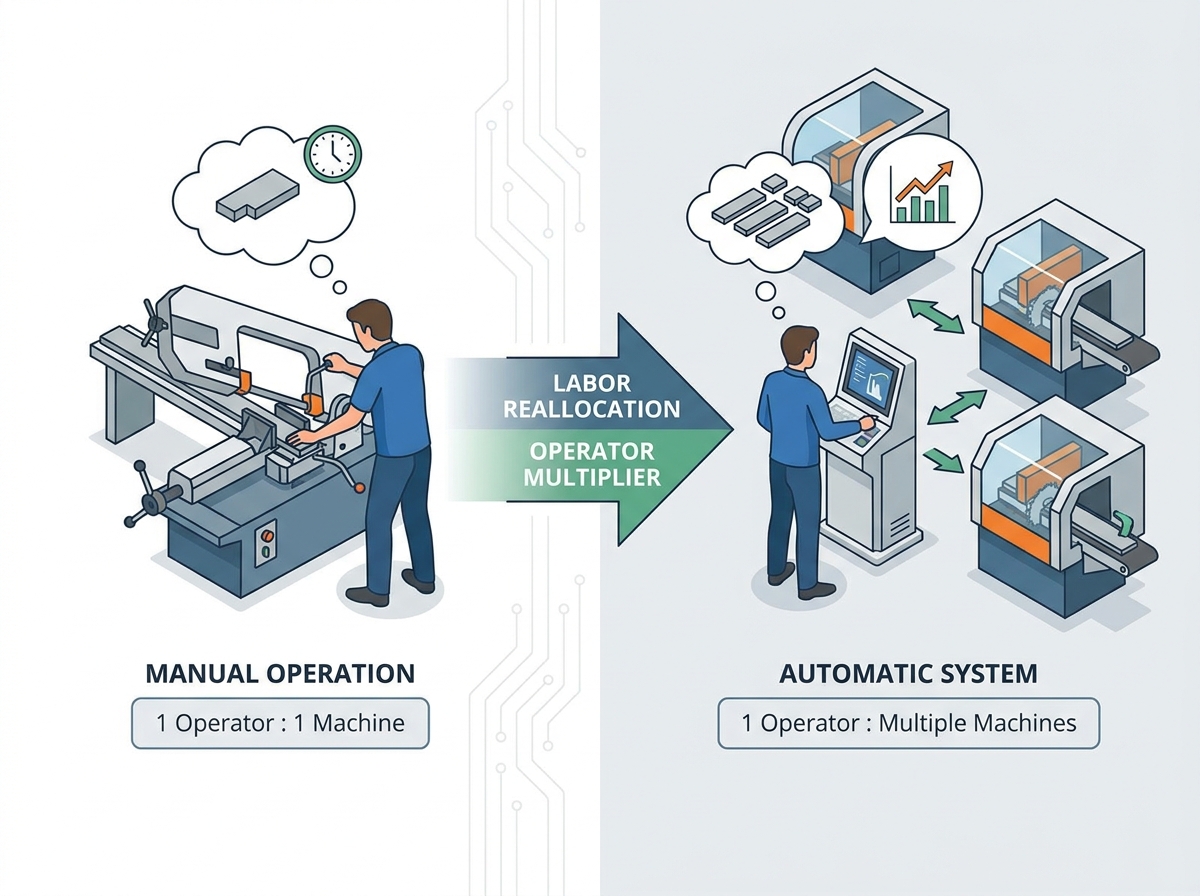
Consider the crucial "operator multiplier" effect. One skilled machinist can easily run three automatic saws concurrently. A manual machine demands a strict one-to-one labor ratio. Freeing up this labor generates immediate financial returns. Operators can deburr parts, inspect tolerances, or run a CNC mill while the saw operates autonomously.
Tool life depends heavily on consistent feed pressure. Automatic hydraulic feeds maintain steady, predictable chip loads per tooth. This mechanical stability drastically extends blade life. Manual operation inherently causes erratic pressure spikes. Human arms tire, causing sudden feed drops or aggressive surges.
Material yield also improves dramatically. NC machines utilize optimized nesting programs directly from the controller. They calculate the most efficient cut-offs automatically. This reduces expensive scrap to an absolute minimum. A quality Saw Blade Machine ensures every single millimeter of material is utilized properly, protecting your profit margins on raw materials.
Safety compliance heavily favors automated setups. Modern automated machines completely enclose the dangerous cutting area. They utilize electronic interlocks on all access doors. You cannot run the machine if a guard is out of place.
Some advanced safety mechanisms prevent catastrophic injuries entirely. Auto-stop capacitance technology detects human flesh instantly. The system drops the blade below the table before serious injury occurs. Automation inherently separates human hands from the active hazard zone, lowering liability and creating a safer shop culture.
Automated machinery brings incredible operational benefits. However, implementing them requires careful facility preparation. Hidden installation costs can quickly derail your upgrade budget if you fail to plan appropriately.
Automated machines demand robust electrical and pneumatic infrastructure. An automatic Saw Blade Machine often requires dedicated three-phase power to handle heavy-duty servo motors. Pneumatic shuttle vises need a constant supply of clean, dry compressed air. You must also account for a much larger floor footprint. Automated in-feed and out-feed roller tables consume significant shop space. You cannot cram these systems into a tight corner.
Repairing a basic manual band saw is relatively straightforward. Most in-house maintenance teams can swap belts, replace basic bearings, or fix a leaky coolant pump. Automatic units introduce immense electronic complexity. You will likely need specialized technicians for deep repairs. Troubleshooting programmable logic controllers (PLCs), servo motors, and sensitive hydraulic sensors requires advanced diagnostic tools. You must factor specialized preventative maintenance into your yearly budget.
Do not underestimate the human element of this transition. Moving from manual to NC requires a complete mental shift for your staff. Operators move from "feel-based" machining to programming-based operation. They must learn feeds, speeds, and software interfaces. They need comprehensive training to avoid costly programming crashes. A veteran manual operator might struggle initially with digital inputs. Providing proper vendor training bridges this gap smoothly.
We can map your decision to three common operational scenarios. Identify which specific profile best matches your current business model to make the correct choice.
You handle constant, unpredictable variety. You might cut aluminum extrusions one hour and solid tool steel the next. We strongly recommend staying with a manual or moving to a basic semi-automatic machine. We justify this choice by analyzing setup times. Programming an automatic machine takes several minutes. This setup time completely negates the cutting speed advantage if you only need two pieces of a specific length. Flexibility remains your greatest asset.
Your business is growing fast. You handle larger structural contracts and repetitive beam work. We highly recommend a semi-automatic machine. It immediately removes the massive physical strain of cutting heavy stock. It regulates blade life effectively through controlled down-feeds. Crucially, it avoids the steep capital expenditure of full NC bar feeders. It balances your budget and productivity perfectly, bridging the gap toward full automation.
You cut thousands of identical parts weekly. You must meet strict tolerance demands for downstream robotic welding. We strongly recommend fully automatic or NC systems. The massive upfront cost is quickly amortized. You save incredible amounts on direct labor. You reduce material scrap exponentially through nesting. You guarantee dimensional consistency across tens of thousands of parts. Full automation is the only way to scale this volume sustainably.
The "best" cutting equipment is never a universal answer. It is strictly a function of your operational volume and labor strategy. Manual equipment provides unmatched flexibility for custom work. Automated solutions provide the necessary scale for mass production. You must align the machine capabilities with your specific business goals, evaluating throughput, precision, and infrastructure readiness.
Do not make a capital expenditure blindly. Request comprehensive time-study analyses from equipment vendors. Insist on test-cut demonstrations using your actual shop material. Verify the proposed cycle times in person. Evaluate the software interface firsthand to ensure your operators can manage it. Take these actionable steps to guarantee your investment delivers the expected returns.
A: Return on investment usually takes between 12 and 24 months. This timeline depends heavily on your specific shift structures. The primary financial offsets come from reallocating labor. A single operator running multiple machines slashes your cost per part. You will also see significant savings from extended blade life and reduced material waste.
A: No, this is generally not feasible. Semi-automatic and fully automatic machines use entirely different foundational chassis designs. Automatic systems require integrated PLCs, different hydraulic routes, and servo-driven ball screws for feeding. You cannot bolt these onto a basic frame. Always project your capacity needs five years out before purchasing.
A: The blade material depends on the metal being cut, not just the machine. However, automatic machines allow you to use higher-end, thinner-kerf blades. Because the machine perfectly controls the downward feed rate, it prevents sudden pressure spikes. This stability prevents premature tooth stripping, letting premium blades perform optimally.
A: Modern safety systems rely on electrical capacitance monitoring. The machine continuously runs a small electrical signal through the blade. Human tissue is highly conductive compared to dry wood or most workpiece setups. When flesh contacts the blade, it changes the signal. This instantly triggers a heavy-duty braking mechanism to stop the blade.