Views: 0 Author: Site Editor Publish Time: 2026-10-30 Origin: Site
Purchasing industrial cutting equipment requires significant capital investment. Over-speccing wastes your valuable budget immediately. Under-speccing creates severe production bottlenecks down the line. Manufacturers frequently highlight peak performance metrics on their glossy brochures. Yet, actual factory-floor value depends heavily on sustained continuous-duty cycles. Material compatibility also dictates real-world success. Failing to match these specifications to your materials leads to premature equipment wear.
We provide an evidence-based framework below. You will learn how to translate technical specifications into measurable outcomes. Understanding torque, RPM control, and structural rigidity changes your buying strategy. You can avoid costly secondary operations by prioritizing the correct features. Let us explore the critical parameters you need to secure a reliable system.
You must define clear success criteria before evaluating any equipment. The right Saw Blade Machine eliminates tedious secondary operations. It delivers a clean, precise cut directly from the blade. This precision removes the need for manual deburring. Your operators save hours of physical labor each week. Clean cuts also ensure seamless fitment during subsequent welding or assembly stages. You achieve higher throughput when parts move straight from the saw to the next workstation. Evaluating equipment solely on upfront price ignores these downstream operational benefits.
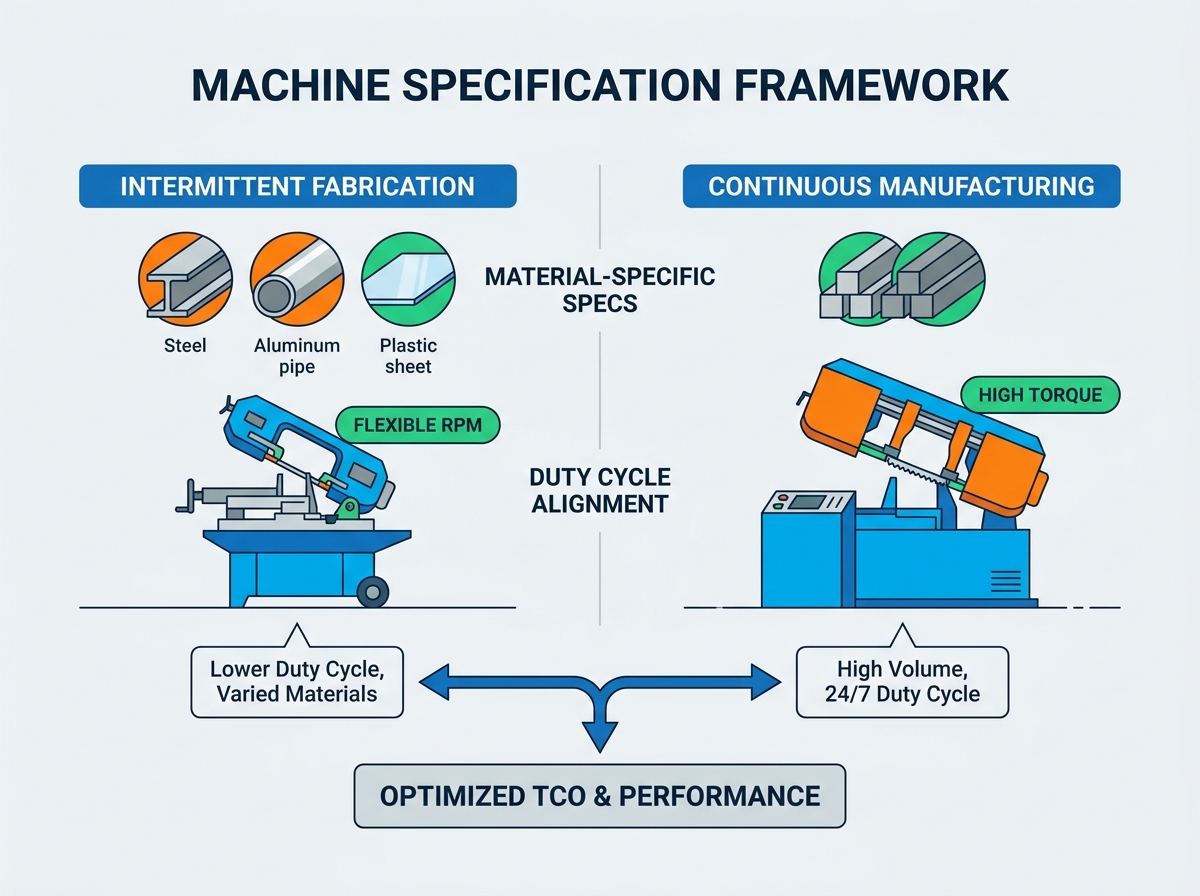
Assess the primary materials your facility processes daily. Ferrous metals require specific mechanical setups. Solid steel bars need high-torque, low-RPM specifications. These parameters prevent the blade teeth from overheating. Non-ferrous metals and plastics demand entirely different settings. Cutting aluminum requires much higher spindle speeds to clear chips effectively. You cannot cut both metal families efficiently using a single fixed setting. Attempting this compromise always destroys blades and ruins material finishes. Profile your stock materials carefully to dictate the required speed ranges.
Duty cycle expectations drastically alter your machine requirements. Differentiate between intermittent fabrication shop use and continuous three-shift manufacturing. Intermittent saws have ample time to cool down between occasional cuts. Continuous-duty machines run constantly under immense mechanical loads. Specifying a machine designed for intermittent use in a high-volume setting guarantees trouble. It inevitably leads to premature motor burnout and structural fatigue. Be realistic about how many hours the equipment will run daily. Overestimating duty cycles provides a safety margin. Underestimating them leads to catastrophic equipment failure.
Motors drive the entire cutting process. Evaluate sustained horsepower (HP) and kilowatt (kW) ratings carefully. Peak horsepower only matters during the initial spin-up phase. Sustained ratings dictate how well the machine handles continuous cutting loads. A motor rated for high sustained output powers through dense materials without stalling.
Compare drive types to match your operational needs. Direct-drive gearboxes transfer torque efficiently to the spindle. They require lower maintenance over a multi-year lifespan. Belt-driven systems offer different mechanical advantages. Belts naturally dampen motor vibration effectively. They also act as a mechanical fuse if the blade jams. Operators find belt replacement relatively easy compared to rebuilding a damaged gearbox.
Table: Drive System Comparison
| Drive Type | Torque Transfer Efficiency | Vibration Dampening | Maintenance Requirements | Best Application |
|---|---|---|---|---|
| Direct-Drive Gearbox | High (minimal power loss) | Low to Moderate | Low (annual oil changes) | Heavy solid steel cutting |
| Belt-Driven System | Moderate (slight slippage possible) | High | Moderate (belt tensioning/replacement) | General fabrication, mixed materials |
Spindle speed flexibility gives you a massive competitive edge. Look for machines utilizing Variable Frequency Drives (VFD) or multi-speed gearboxes. Fixed-speed machines severely limit operational agility. They force operators to compromise on cut quality. Applying the wrong RPM increases the risk of work-hardening sensitive materials. Once a material work-hardens, cutting becomes nearly impossible. VFDs allow operators to dial in the exact RPM required. This flexibility prevents thermal shock to the carbide teeth. It ensures optimal chip loads across diverse metal profiles.
Arbor size and blade diameter compatibility require close attention. Ensure the equipment supports industry-standard arbor sizes. Proprietary arbors lock you into high-cost, single-source consumables. Supply chain issues can halt your production if proprietary blades become unavailable. Standardized arbors let you source tooling from multiple competitive vendors.
Calculate your maximum required cutting depth accurately. This calculation determines the minimum necessary blade diameter. Always factor in clearance for varied stock shapes. Tubing, solid bar, and structural beams need different clearances. A blade too small will not penetrate the stock fully. A blade excessively large introduces unnecessary flex and wobble.
Chassis and base construction dictate final cut quality. Prioritize heavy-duty cast iron or thickly welded steel bases. Weight acts as an immovable anchor against micro-vibrations. High-frequency micro-vibrations are the primary cause of premature blade dulling. They chip the fragile carbide tips bit by bit. They also create chattered, ugly cuts on the material surface. Cast iron possesses a unique graphite flake structure. This metallurgical structure absorbs resonant frequencies better than standard steel. A heavier base provides a stable foundation for high-tolerance cutting operations.
Vise and clamping mechanisms secure the material during violent cutting forces. Evaluate pneumatic or hydraulic vises for high-volume environments. Automated vises reduce operator fatigue significantly over a long shift. They also ensure consistent clamping pressure across every cycle. Manual vises rely on operator strength, which varies throughout the day.
Miter and indexing accuracy determine downstream joint fitment. Check for hardened degree scales on the pivot base. You need positive mechanical stops at common angles like 45° and 90°. Soft scales wear down over time, ruining your angle precision. Automated setups require even stricter evaluations. Assess the precision of the material feeding systems. NC and CNC controls must feature verifiable tolerance limits. Ask the manufacturer for repeatability data on their indexing shuttles. A feeding system lacking precision negates the benefits of a high-quality blade.
Cutting metal generates immense, localized heat. Lubrication and coolant types manage this dangerous thermal load. Compare flood coolant systems against programmable misting systems carefully. Flood coolant works best for heavy solid steel cutting. It drowns the cutting zone, carrying heat away rapidly. However, flood systems create messy work environments.
Programmable misting systems handle aluminum beautifully. They apply a precise micro-drop of synthetic lubricant directly to the teeth. This method leaves dry chips and maintains much cleaner workspaces. Evaluate your facility's tolerance for fluid maintenance before choosing a system.
Filtration and pump specifications keep the cooling fluid flowing smoothly. Verify the overall capacity of the coolant pump. A weak pump cannot push fluid deep into the cutting channel. Check for the presence of dual-stage filtration systems. Dual-stage filters catch tiny metal fines before they circulate.
Common mistakes to avoid regarding filtration:
Unfiltered abrasive fines will quickly destroy a pump impeller. Upgrading filtration upfront saves significant maintenance headaches later.
Chip clearance keeps the cutting zone safe and efficient. Look for built-in chip drawers for easy manual emptying. Automated chip conveyors handle high-volume waste perfectly. They remove debris continuously without operator intervention. Effective blade brush mechanisms wipe debris away from the gullets. Trapped chips cause a phenomenon called recutting. The blade carries the chip back into the material. Recutting drastically shortens the lifespan of your tooling. It also ruins the surface finish of your freshly cut parts. Proper chip evacuation is vital for continuous operation.
Safety features protect your workforce and your business. Guarding and enclosure systems isolate the immediate danger zone. Ensure the equipment features self-retracting blade guards. These guards expose the blade only when it contacts the material. Fully enclosed cutting cabinets offer maximum physical protection. They physically separate the operator from the cutting zone entirely. Enclosures also contain hazardous coolant mist and flying metal fragments. Never compromise on structural guarding to save a few dollars.
Safety interlocks and electrical compliance prevent catastrophic accidents. Verify the presence of magnetic motor starters. These starters prevent accidental machine restarts after unexpected power failures. Standard switches remain "on" when power drops, creating a severe hazard when electricity returns. Easily accessible emergency stop (E-stop) buttons are absolutely vital. They must be positioned at all operator control stations.
Confirm the machine meets regional safety standards rigorously. OSHA compliance is legally required in the United States. CE marking serves the same regulatory purpose in Europe. Non-compliant machinery opens your facility to immense legal liability. It also puts your valuable operators at unnecessary risk.
Buying industrial cutting equipment requires looking far past the brochure. Maximum capacity numbers rarely tell the whole story of factory performance. Focus instead on continuous duty ratings and structural weight. Prioritize vibration mitigation and material-specific features like variable speeds. The ideal system balances initial capital expenditure against long-term operational efficiency. This strategic alignment ensures minimal downtime and maximum consumable life.
Request test cuts on your specific materials from shortlisted vendors. Verify claimed cycle times and inspect the cut quality personally. Translate technical specifications into real-world business advantages. Apply this framework confidently before generating your next purchase order.
A: Direct drive systems use a gearbox connected directly to the motor, offering maximum torque for heavy solid materials. Belt-driven systems use pulleys and belts, which can slip under extreme loads but offer a smoother cut and protect the motor from sudden jams.
A: A VFD allows operators to precisely dial in the RPM to match the material's hardness and the blade's tooth count. This prevents thermal damage to the blade and ensures an optimal cut across varied metals.
A: Heavier machines absorb the kinetic energy and vibration generated during the cutting process. Less vibration translates directly to smoother cuts, tighter tolerances, and significantly longer blade life.
A: Only if the machine features variable speed control and compatible coolant systems. Steel requires low speeds and high torque, while aluminum requires high speeds. Using a single-speed machine for both ruins blades and produces poor cuts.