Views: 0 Author: Site Editor Publish Time: 2026-11-05 Origin: Site
Purchasing commercial forming equipment represents a high-stakes capital expenditure for any manufacturing facility. A single procurement mistake can derail your operational timeline. It can also severely impact your overall profitability. Choosing incorrect specifications often results in crippling production bottlenecks. You might face excessive material waste or discover tooling incompatibilities late in the process. A successful acquisition must perfectly align hardware capabilities with your exact production targets. You must balance machine speed, automation levels, and physical footprint against your labor availability and product mix.
This guide strips away marketing jargon to provide a clear technical framework. We offer actionable insights for evaluating an industrial press. You will learn how to assess capacity, review core automation, and verify critical facility requirements. Our objective is straightforward. We want to ensure your investment yields a predictable and sustainable return without hidden integration challenges.
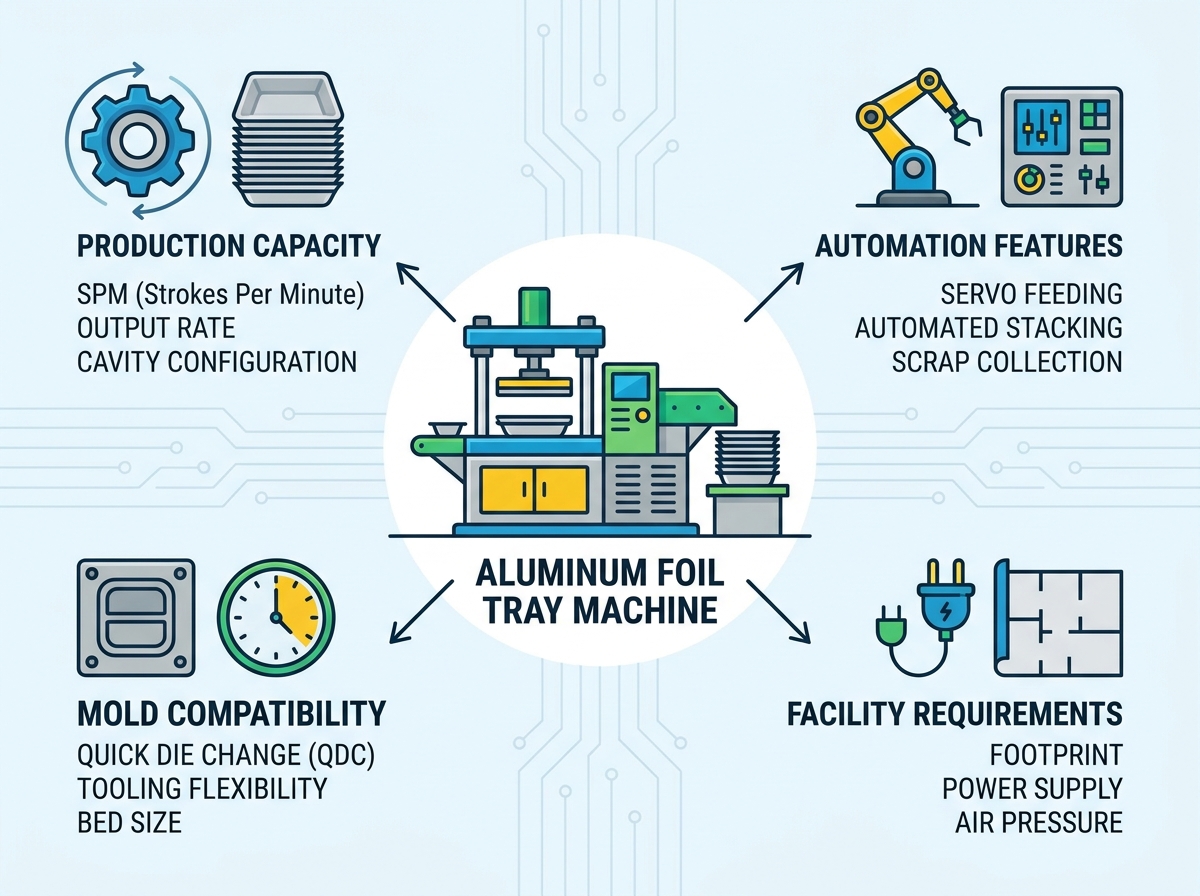
Manufacturers often boast about extremely high production speeds. However, evaluating true capacity requires a highly practical mindset. You must assess the realistic running speed rather than the theoretical maximum. Most industrial machines operate efficiently between 40 to 80 Strokes Per Minute (SPM). This optimal range fluctuates depending on tray depth and aluminum thickness. Pushing a machine beyond its stable SPM threshold causes downstream problems. You will likely experience frequent mechanical jams. You may also notice premature tooling wear.
Next, evaluate the equipment cavity configuration. You need to assess the machine bed size alongside its tonnage capacity. These figures directly determine your multi-cavity potential. Running a 2-cavity mold yields different daily volumes compared to a 6-cavity mold. Higher tonnage allows you to produce more trays per single press stroke.
You can calculate your actual hourly output using a straightforward formula. Multiply your SPM by the number of mold cavities. Then, factor in operational uptime. A well-managed manufacturing facility typically achieves 85% to 90% uptime. This percentage accounts for minor maintenance stops and routine material roll changes.
Finally, consider the severe implementation risks. Purchasing a high-capacity machine without matching downstream automated packaging capabilities spells trouble. An ultra-fast press will simply create immediate production floor bottlenecks. You must ensure your automated packaging equipment can handle the surge. When you deploy a modern Aluminum Foil Tray Making Machine, consider the entire line flow. A synchronized production line ensures consistent output and prevents dangerous material pile-ups.
Modern manufacturing demands intelligent automation to remain competitive. Feeding systems play a massive role in raw material conservation. Look for servo-driven automatic feeders instead of traditional mechanical feeders. Servo control provides absolute step length precision. This precise step movement minimizes expensive foil waste between punches.
Press technology serves as the heart of your operation. Compare standard pneumatic clutch presses against fully servo-driven presses. Servo presses offer superior precision. They produce significantly lower noise levels. Furthermore, the smooth motion profile of a servo press extends mold life dramatically.
Table: Press Technology Comparison Guide
| Feature Category | Pneumatic Clutch Press | Fully Servo-Driven Press |
|---|---|---|
| Precision Control | Moderate step accuracy | High digital accuracy |
| Operational Noise | High impact decibels | Low consistent hum |
| Mold Preservation | Standard wear limits | Extended tooling lifespan |
| Energy Efficiency | Average consumption | Highly optimized power usage |
Automated stacking represents another critical automation layer. Evaluate the stacker mechanism carefully. It must handle different tray shapes seamlessly. Drop-stackers suit simpler shapes. Vacuum-suction stackers offer better control for complex geometries. Your choice here directly impacts the speed of final packing.
Do not overlook scrap collection mechanics. Aluminum raw material is a massive ongoing expense. Efficient automated scrap pressing is non-negotiable. Balers and aspirators compact leftover foil web efficiently. This maximizes your recycling revenue. It also maintains a clean, hazard-free workspace for your team.
Production agility depends heavily on how fast you swap product lines. Bed size and shut height form the baseline. You must ensure the press specifications accommodate your largest expected tooling dimensions. If the shut height is too shallow, large molds simply will not fit. This forces costly machine upgrades later.
Quick Die Change (QDC) systems revolutionize production floors. Operations requiring frequent product swaps benefit immensely here. QDC systems use hydraulic clamps and mold lifters. They reduce manual labor significantly.
To achieve a rapid changeover, operators typically follow these sequential steps:
This process reduces changeover times from 4 hours to under 45 minutes.
Tooling standardization also warrants serious attention. Verify if the machine accepts industry-standard molds. Avoid equipment locking you into proprietary manufacturer tooling. Proprietary tooling restricts your sourcing options. It also inflates future replacement costs.
Finally, monitor potential wear and tear factors. Check if the machine framework is robust enough. The slide block guides must minimize vibration perfectly. Excessive vibration remains the primary cause of premature mold wear. A heavy, cast-iron frame absorbs operational shocks much better than lighter alternatives.
Integrating heavy machinery requires precise facility planning. Space allocation goes far beyond the main press footprint. You must calculate the total area required for the entire production line.
Electrical requirements demand a thorough audit of your facility power supply. Commercial machines typically require robust 3-phase industrial power. Standard single-phase systems cannot handle the startup load. Compare the total kW consumption against your projected energy budgets. Upgrading your electrical panels post-delivery creates massive delays.
Pneumatic specifications are equally crucial. These tray machines rely heavily on compressed air. They use air for part ejection, lubrication, and automated stacking. Verify the required air pressure in megapascals (MPa). Also, check the required air volume in cubic meters per minute (m³/min). Ensure your existing factory compressors can handle this continuous load without pressure drops.
Partnering with a reliable equipment manufacturer protects your capital investment. Safety and certifications act as your first screening filter. Demand definitive proof of safety compliance. You need CE certification for the European market. You need OSHA-compliant guarding for operations inside the US. Look closely for essential safety mechanisms. Dual-hand controls and light-curtain safety sensors protect your operators from injury.
Component origins tell you a lot about machine quality. Check the sourcing of critical electrical and pneumatic parts. Premium machines utilize reputable brands like Siemens, Mitsubishi, or SMC. Standardized international parts make localized repairs entirely possible. Off-brand proprietary electronics often lead to prolonged downtime when components fail.
Investigate the after-sales service structure rigorously. Clarify the protocol for remote troubleshooting before signing a contract. Understand the daily cost of commissioning and installation engineers. Additionally, ask about the guaranteed lead time for critical spare parts. A responsive manufacturer should dispatch replacement parts within 48 hours. Lacking a solid support structure turns minor glitches into catastrophic production halts.
Selecting the right equipment requires a calculated shortlisting logic. Narrow your options by matching your highest-volume product requirements to the machine sweet spot. Look closely at tonnage capabilities and bed size dimensions. Avoid paying a massive premium for extreme tonnage if you only produce small, single-use airline containers. Oversized equipment wastes energy and floor space.
Move forward with concrete next-step actions. Before issuing a purchase order, request a live equipment demonstration. Alternatively, ask for an unedited video run-off. Ensure they use your specific gauge and alloy of aluminum foil during the test. This proves the machine handles your actual raw material perfectly. Calculate your precise ROI based on your local labor rates and electricity costs. Rigorous planning guarantees your new machinery elevates your entire manufacturing capability.
A: Tonnage typically ranges from 45T to 80T or more. A 45T to 63T press is generally sufficient for standard 1-to-3 cavity food containers. However, an 80T+ capacity is strictly required for deep-draw trays or massive 4-to-6 cavity molds.
A: A well-calibrated machine featuring precision servo feeding keeps raw material scrap between 12% and 18%. This rate fluctuates depending on the exact shape of the tray. Circular trays naturally yield more web scrap than rectangular designs.
A: Yes, the primary machine press can run both styles efficiently. The press simply needs the appropriate tonnage and pneumatic capabilities. The real difference lies entirely in the engineering complexity and cost of the molds themselves.
A: Depending on your specific customization requests, expect 30 to 60 days for core machine manufacturing. You should anticipate an additional 45 to 60 days for custom mold design and rigorous factory testing prior to initial shipment.