Views: 0 Author: Site Editor Publish Time: 2026-09-23 Origin: Site
The gap between a manufacturer’s theoretical maximum speed and actual shop-floor output creates massive headaches. Procurement teams often base calculations on optimistic nameplate capacities. This misstep leads to severely skewed return-on-investment models. You end up buying converting equipment expecting a high volume but fall significantly short on the floor. We must bridge this gap. This article provides procurement and production engineers with a transparent, reality-based framework. We aim to replace optimal-condition vendor claims with hard data. You will learn how to accurately calculate your true foil rewinding machine output. We will break down essential variables like cycle times, material constraints, and acceleration curves. You will also see how Overall Equipment Effectiveness directly impacts theoretical projections. Finally, we outline exactly how to scrutinize vendor claims before you finalize a purchase.
You cannot evaluate equipment based solely on its top speed. A machine running at 300 meters per minute does not produce 300 meters of finished product every minute. Non-productive seconds accumulate quickly. To find your true capacity, you must analyze the complete mechanical cycle.
We start by defining the primary variables. Web Speed (V) represents your running speed in meters per minute. Roll Length (L) defines your finished product length in meters. Changeover Time (Tc) represents the non-running time between finished rolls, measured in seconds. You need these three numbers to calculate your base cycle.
First, calculate your Run Time per Roll (Tr). This is the time the machine spends actively pulling material. Use this simple sequence:
Next, calculate your Total Cycle Time. You simply add your Run Time (Tr) to your Changeover Time (Tc). This combined figure gives you the exact duration required to produce one complete roll from start to finish. If your run time is 10 seconds and your machine takes 5 seconds to cut and swap cores, your total cycle time is 15 seconds.
Once you know the total cycle time, scaling up to shift volume becomes straightforward mathematics. You need to determine how many complete cycles fit into a single minute.
If you run an 8-hour shift and expect 7.5 hours of active production, you multiply your hourly output by 7.5. This calculation provides your absolute maximum theoretical yield for the day.
Vendors frequently highlight maximum meters-per-minute (m/min) in their brochures. Evaluating a machine based strictly on this metric leads to overestimating production capacity. A machine rated for 600 m/min might look twice as productive as a 300 m/min model. However, if you run short 10-meter consumer rolls, the machine spends more time stopping, cutting, and changing cores than it does running at full speed.
High web speeds matter most for long industrial catering rolls. For shorter rolls, changeover efficiency dominates the output equation. Relying on nameplate speed guarantees a shortfall in your production projections.
| Metric | Nameplate Claim (Vendor) | Real-World Application | Impact on Output |
|---|---|---|---|
| Web Speed | 600 m/min maximum | Averages 450 m/min due to ramp times | Reduces yield by ~20% |
| Changeover Time | "Instant" or 2 seconds | 5-7 seconds including glue application | Limits rolls per minute |
| Uptime | 100% continuous operation | 85% due to master roll splicing | Cuts shift total by 15% |
Calculations on paper assume perfect material behavior. On the shop floor, raw material characteristics and machine mechanics dictate your actual limits. You must adjust your mathematical models to account for physical reality.
Aluminum foil is notoriously fragile. Your foil's gauge directly influences how fast you can run the equipment. Thinner gauges, particularly in the 9 to 11-micron range, possess very low tensile strength. They tear easily under sudden tension spikes.
Running thin materials requires you to program reduced acceleration profiles. The machine must gently ramp up to operating speed and decelerate smoothly. You cannot utilize aggressive start-stop cycles. Consequently, your average running speed drops far below the theoretical maximum. If you attempt to push thin foil to the machine's top speed, you invite frequent web breaks. A single web break can cost you 10 to 15 minutes of downtime, destroying your shift output.
How your machine handles cardboard cores creates massive variances in cycle time. We can categorize these mechanisms into three distinct levels of efficiency:
When producing high volumes of short rolls, upgrading your gluing mechanism yields more output than upgrading your main drive motor.
Removing the finished product from the winding shaft also impacts the continuous operating cycle. Manual removal requires the machine to come to a complete stop. The operator must physically pull the roll clear and inspect it before the next cycle begins. This operator dependency creates inconsistent delay times.
Auto-ejection mechanisms push the finished roll onto a conveyor system automatically. This eliminates operator hesitation. The machine immediately clamps the next core and resumes winding. Factoring out human intervention ensures your Total Cycle Time remains a fixed, predictable constant.
You cannot project accurate yields without applying OEE principles. The widely accepted Total Productive Maintenance (TPM) framework breaks equipment efficiency into Availability, Performance, and Quality. Incorporating these modifiers turns your theoretical math into reliable business data.
Availability measures the proportion of scheduled time your machine actually spends running. No equipment operates continuously for an entire shift. You must deduct time for planned and unplanned stops.
Accounting for scheduled maintenance, daily cleaning, and operator breaks is mandatory. Furthermore, you must calculate the time lost to master roll changeovers. When a jumbo roll of foil depletes, the operator must load a new roll and splice the web. This process halts production entirely. For standard operations, a typical Bottom-of-Funnel (BOFU) assumption dictates factoring a 10% to 15% availability loss into your daily projections.
Performance evaluates whether the machine runs at its theoretical top speed when it is active. As mentioned earlier, machines do not jump instantly from zero to maximum velocity.
You must adjust calculations for ramp-up and ramp-down phases. During these transition periods, the web moves slower than the target speed. For a 20-meter consumer roll, the machine might spend 30% of its run time accelerating and decelerating. This means it never operates at maximum speed for the entire roll length. You should deduct an additional 5% to 10% from your theoretical output to account for these inherent speed losses.
Producing rolls does not matter if those rolls fail quality control. Quality measures the proportion of acceptable units versus total units produced. You must deduct output for rejected products.
Common foil defects include telescoping edges, incorrect tension (spongy rolls), and loose winding at the core. You cannot count these scrapped rolls in your final production numbers. To find your true output, you must apply a final formula adjustment.
Formula adjustment: Actual Yield = Total Shift Output × (1 - Scrap Percentage). If you project 10,000 rolls per shift but experience a 3% scrap rate, your actual yield is 9,700 sellable units.
Standard stop-and-cut models limit production ceilings because the web must halt entirely during changeovers. Reaching higher tiers of production requires fundamentally different architecture. You must evaluate when upgrading to advanced machinery makes financial sense.
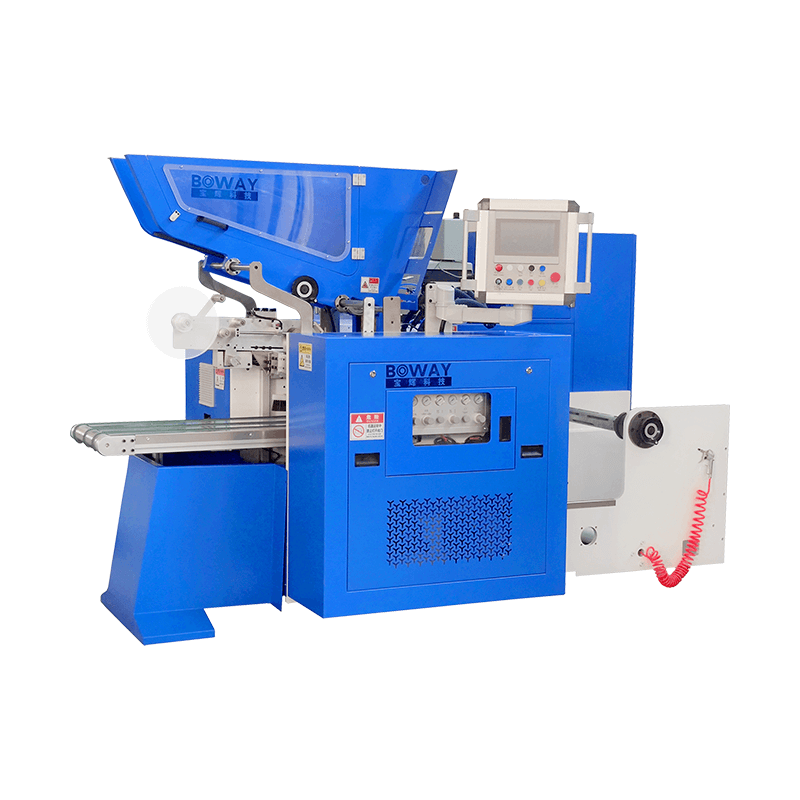
Turret architectures eliminate the traditional start-stop bottleneck. A high-capacity foil rewinding machine utilizes a rotating multi-shaft turret. While one shaft actively winds the foil at full speed, the second shaft automatically ejects the finished roll and loads a fresh core.
When the preset length is reached, the turret rotates. The web cuts and transfers to the new core simultaneously. This creates continuous winding. Zero-stop changeovers fundamentally change the output formula. Your Changeover Time (Tc) essentially becomes zero. Your output is now dictated entirely by web speed and master roll availability.
High volume output creates secondary bottlenecks downstream. If a turret machine produces 30 rolls per minute, human operators cannot pack them fast enough. You must evaluate the integration of robotic handling.
Automated core sorting hoppers feed the machine continuously. Finished roll conveyor systems transport the product directly to shrink-wrapping or cartoning stations. Implementing these systems eliminates labor bottlenecks. They ensure the machine never waits on a human operator. The output remains steadily predictable throughout the entire shift.
Advanced automation requires significant capital. You justify this investment by calculating the cost-per-roll tipping point. You must weigh the premium equipment price against long-term operational savings.
A continuous turret machine produces exponentially more volume per shift than a standard model. It also requires fewer operators per line. The premium price of the equipment is offset by reduced direct labor costs and substantially higher per-shift volume. When your market demand exceeds the theoretical maximum of standard stop-and-cut machines, upgrading becomes a mathematical necessity rather than a luxury.
Equipment manufacturers market their machines aggressively. You cannot accept their baseline numbers as a guarantee. You must force vendors to prove their claims using your specific operational parameters.
Refuse generic speed claims immediately. A brochure stating "Up to 500 meters per minute" tells you nothing about actual productivity. You must provide your exact material specs and demand customized calculations.
Ask vendors highly specific questions: "What is the guaranteed output for a 300mm wide, 10-micron foil running 50-meter consumer rolls?" If a supplier cannot or will not provide data based on these variables, estimating your true foil rewinding machine output becomes impossible. Force them to show their cycle time math.
Dig deeper into the machine's programming. Verify exactly how long the equipment takes to reach peak speed and how long it takes to brake safely.
Slower ramp times heavily dilute output on short-length rolls. If the motor requires 4 seconds to reach top speed safely without breaking thin foil, that is 4 seconds of reduced-speed production per cycle. Ask the vendor to provide a speed profile graph for your specific roll length. This visualizes exactly how much time is lost to acceleration.
Never sign off on equipment based on a 5-minute demonstration run. Short tests do not reveal thermal expansion in brakes, glue viscosity changes, or tension drift.
Mandate a continuous 1-to-2-hour test run at the vendor's facility before shipping. You must supply your specific raw materials, including your exact foil gauge and cardboard cores. Measure the exact OEE during this prolonged FAT. Record every web break, every rejected roll, and the true average cycle time. Validate their output claims with your stopwatch, not their sales material.
Calculating accurate output relies on prioritizing total cycle time and realistic OEE over maximum theoretical web speeds. Do not let nameplate capacities dictate your business planning. You must account for acceleration limits, material fragility, and the very real impact of manual interventions on the shop floor. Upgrading your equipment only makes sense when automation directly eliminates non-productive changeover seconds.
Your next-step action is straightforward. Outline your specific production parameters, including roll length, web width, foil thickness, and desired shift volume. Build a standardized output projection spreadsheet using the formulas provided in this article. Require all shortlisted vendors to complete your spreadsheet. Compare their cycle time claims directly against your mathematical reality.
A: Shorter rolls require more frequent changeovers. For short consumer rolls (e.g., 5m - 20m), the changeover time limits your overall output far more than the maximum running speed. You spend a higher percentage of your shift stopping, cutting, and starting rather than actively winding material.
A: Semi-automatic machines typically average 10 to 15 seconds per changeover, as they still require some operator intervention for gluing or offloading. Fully automatic turret machines reduce this non-running time to 2 to 5 seconds, and in some continuous setups, effectively zero seconds.
A: Operational constraints usually prevent max speeds. Improper tension settings, low-quality master rolls causing web breaks, and required gentle acceleration profiles for thin materials all force you to run slower. Operator hesitation during manual offloading also drags down average speeds.
A: Track the total raw material weight going into the machine versus the total acceptable finished roll weight coming out. Deduct the rejected rolls (due to telescoping or bad tension) from your total count. Multiply your total theoretical output by your acceptable yield percentage to find your true number.